Nonresident Annual Fishing License Cost in Kentucky
You are planning a spring crappie trip to Kentucky Lake or a fall smallmouth run on the Cumberland, and the license website offers a dizzying list of nonresident options. Buy the wrong one and you either waste money or end up on the water without the permit you actually needed. This guide explains the nonresident annual fishing license cost in Kentucky and how to decide whether it is the right buy.
What a Nonresident Annual License Costs in Kentucky
Let me start with the number everybody is looking for. The Kentucky nonresident annual fishing license costs $58.14. That covers you for the full Kentucky license year, which runs from March 1 through the last day of February. It is the license most out-of-state anglers end up with once they realize they are coming back more than once or twice a year.
I get why people hesitate at that price. When you are already paying for gas, a cabin, boat fuel and bait, another $58 can feel like one more toll booth. But once you look at how the shorter licenses add up, the annual option often turns out to be the cheapest way to fish Kentucky for anyone who visits more than a few days a year.
How the Annual Compares With Short-Term Licenses
Kentucky sells three main nonresident fishing licenses. Here is how they stack up side by side, along with the resident annual license for reference.
| License | Cost | Valid For | Best For |
|---|---|---|---|
| Nonresident 1-day | $15.86 | One calendar day | A single day of fishing on a road trip |
| Nonresident 7-day | $37 | Seven consecutive days | One weeklong vacation |
| Nonresident annual | $58.14 | March 1 through the end of February | Multiple trips or long stays |
| Resident annual, for reference | $24.31 | March 1 through the end of February | Kentucky residents |
| Trout permit, any angler | $10.57 | License year | Anyone fishing for or keeping trout |
If you want the full rundown on the short-term options, Nonresident 7-Day Fishing License Cost in Kentucky and Nonresident 1-Day Fishing License Price in Kentucky go deeper on each.
Why Nonresidents Pay More
Every state charges nonresidents more than residents, and Kentucky is no exception. Resident anglers support the state’s fish and wildlife agency through taxes and other fees throughout the year, and higher nonresident license prices help balance that out. The money from license sales supports hatcheries, stocking, fisheries research, boat ramps and enforcement. When you buy a Kentucky license, you are helping pay for the trout stockings below Wolf Creek Dam and the crappie habitat work on the big reservoirs.
It also helps to put the price in context. Spread over a full license year, $58.14 works out to less than the cost of a tank of boat fuel, and it opens up two of the best crappie lakes in the country, a trophy trout tailwater and hundreds of miles of smallmouth rivers.
Fees You Might See at Checkout
When you buy your license online or at a retailer, you may notice a small processing or convenience fee added to the license price. That fee is set by the vendor or the licensing system, not by the license itself, and it can vary. If you are budgeting tightly, plan for a few extra dollars on top of the listed price.
When the Annual License Saves You Money
The real question is not what the annual license costs. It is whether it costs less than the alternatives for your particular trips.
Doing the Break-Even Math
Here is the simplest way to think about it. Three separate 1-day licenses cost $47.58, which is still less than the annual license. Four separate 1-day licenses cost $63.44, which is more than the annual. So if you plan to fish four or more separate days during the license year, the annual license is the better deal.
The 7-day license changes the math for vacation anglers. One weeklong trip at $37 is clearly cheaper than the annual. But two weeklong trips at $37 each add up to $74, which is more than the $58.14 annual. If there is any chance you will make two separate trips during the license year, the annual pays for itself.
| Your Plan | Cheapest Option | Total Cost |
|---|---|---|
| One single day of fishing | Nonresident 1-day | $15.86 |
| Two separate days | Two 1-day licenses | $31.72 |
| Three consecutive days in one trip | Nonresident 7-day | $37 |
| One full week of fishing | Nonresident 7-day | $37 |
| Four or more separate days | Nonresident annual | $58.14 |
| Two weeklong trips | Nonresident annual | $58.14 |
Real-World Scenarios
Consider an angler from Indiana who drives down to Lake Cumberland twice a year, once in spring for walleye and once in fall for stripers. Each trip lasts about four days. Two 7-day licenses would cost $74, while the annual license costs $58.14. The annual is the clear winner, and it also covers any extra weekend that comes up.
Now consider a family from Ohio taking a single summer vacation to a rented cabin on Kentucky Lake. They plan to fish four or five days that week, and they do not expect to return until next year. The 7-day license at $37 is the best choice for each adult angler.
Finally, consider a tournament angler from Tennessee who fishes events on Kentucky waters several times a year. Unless the events are all on waters covered by reciprocity, which I will explain shortly, the annual license is almost certainly the right buy.
Group Trips and Who Needs What
When a group of friends heads to Kentucky together, every adult nonresident who fishes needs a license of their own. There is no group license, and one person’s annual does not cover a buddy holding a second rod in the same boat. That sounds obvious, but I have watched more than one group get surprised at the ramp when a conservation officer asked to see licenses for everybody holding a rod.
The good news is that each angler can choose the license that fits their own plans. The friend who comes down every spring and fall buys the annual. The brother-in-law who only joins for one long weekend buys a 7-day. The neighbor who fishes one afternoon buys a 1-day. Sorting that out before the trip avoids awkward conversations at the dock.
Timing Your Purchase Around the License Year
Because the Kentucky license year runs from March 1 through the end of February, timing matters. If you buy a nonresident annual license in late January, it will expire at the end of February, just weeks later. If you are planning a winter trip in January or February and another trip in spring, you might end up needing two annual licenses for what feels like the same season.
The smart move is to buy your annual license in early March if you plan to fish Kentucky during the coming spring, summer and fall. For more on how the license year works, see Kentucky Fishing License Year Runs March 1 to February 28.
Add-Ons You May Need on Top of the Annual
The annual license is the foundation, but there are a few situations where you need something extra.
The Trout Permit
If you plan to fish for trout or keep any trout, you need a trout permit in addition to your fishing license. The trout permit costs $10.57, and that price is the same for residents and nonresidents. Add it to the nonresident annual and your total is $68.71 for the license year.
This matters for anglers headed to the tailwaters below Wolf Creek Dam on the Cumberland River, below Laurel River Dam or to any of the many stocked trout streams in the state. Even if trout are not your main target, if you are fishing a tailwater where trout are common, the permit is cheap insurance. For details, see Kentucky Trout Permit Cost and Requirements.
Paddlefish and Other Special Permits
Some types of fishing need their own permits or carry special rules. Paddlefish snagging, for example, has its own regulations and may require a separate permit. If you are interested in less common methods like snagging, gigging or bowfishing, check the specific rules before you go. For paddlefish in particular, see Do You Need a Special Permit to Snag Paddlefish in Kentucky?.
Boats and Other Costs
Your fishing license does not cover boat registration. If you are bringing a boat from another state, it generally needs to be registered in your home state, and some lakes have their own launch or day-use fees. Marinas and campgrounds also charge their own fees. These are not part of the license price, but they belong in your trip budget.
Fishing and Hunting on the Same Trip
Many out-of-state visitors combine fall fishing with a hunting trip, especially in western Kentucky around the Land Between the Lakes region. A nonresident fishing license does not cover hunting, and nonresident hunting licenses and permits are separate purchases with their own prices. Kentucky does offer combination licenses for residents, but nonresidents should look carefully at what is available to them and compare the cost against buying separate licenses.
If you plan to hunt ducks on Lake Barkley in the morning and fish for crappie in the afternoon, make sure you have every license, permit and stamp you need for both activities.
Reciprocity, Exemptions and Free Fishing Days
Not every nonresident needs a Kentucky license for every trip. A few rules can save you money if they apply to you.
Tennessee Reciprocity on the Big Lakes
Kentucky and Tennessee have a long-standing reciprocal agreement that affects Kentucky Lake and Lake Barkley. In general, an angler with a valid fishing license from either state can fish the main portions of these lakes, including the parts in the other state. However, the agreement does not usually cover tributaries, embayments and certain areas, and the rules can be detailed.
If you are a Tennessee resident fishing only the main lake, you may not need a Kentucky license at all. If you plan to fish a Kentucky creek arm or tributary, you probably do. Read Tennessee-Kentucky Fishing License Reciprocity Rules before relying on reciprocity.
Kids and Other Exemptions
Kentucky does not require young anglers under a certain age to buy a fishing license, which can save families a lot of money. Check What Age Can Kids Fish Without a License? for the exact cutoff. There are also exemptions and special licenses for certain groups, such as some disabled anglers and military members, so it is worth looking into whether anyone in your group qualifies.
Free Fishing Weekend
Kentucky holds a free fishing weekend each year in early June, when anglers can fish without a license, and that includes nonresidents. It is a great time to introduce friends or family to fishing in Kentucky without any upfront cost. Keep in mind that size and creel limits still apply during free fishing days. For details, see Can Nonresidents Fish Free During Kentucky’s Free Fishing Weekend?.
Where Nonresidents Put Their Annual License to Work
It helps to know where most out-of-state anglers end up, because the waters you plan to fish affect which permits you need and how many trips you are likely to make.
Kentucky Lake and Lake Barkley
These twin reservoirs in western Kentucky draw anglers from across the Midwest and South. Spring crappie fishing is the headline act, but the lakes are also famous for largemouth bass on the ledges in summer, smallmouth on rocky points and catfish year-round. Because so many visitors come back several times a year, this is where the annual license often makes the most sense. Remember the reciprocity rules if you hold a Tennessee license, and know which parts of each lake fall under the agreement.
Lake Cumberland and the Cumberland River Tailwater
Lake Cumberland in south-central Kentucky is known for striped bass, walleye and crappie, while the cold tailwater below Wolf Creek Dam holds rainbow and brown trout. Many anglers fish the lake and the tailwater on the same trip, which means the trout permit is a must. With $58.14 for the annual and $10.57 for the trout permit, a full year of access to both costs $68.71.
Rivers, Streams and Smaller Lakes
Kentucky’s smaller waters often get overlooked by visitors, but they offer great fishing. Smallmouth anglers float rivers like the Green, Barren and Elkhorn Creek. Eastern Kentucky lakes offer bass and muskie, and many state park lakes are stocked with catfish and trout. An annual license lets you explore these waters on short side trips without buying a new license each time.
How to Buy and Carry Your Nonresident License
Buying Online or at a Retailer
You can buy a Kentucky nonresident fishing license online through the state fish and wildlife agency’s licensing system, by phone or at many sporting goods stores, bait shops and big-box retailers in Kentucky. Online is usually the fastest option, and you can do it before you leave home.
- Visit the official Kentucky licensing website or call the licensing line.
- Create a customer profile or look up your existing record.
- Select nonresident status and choose the annual fishing license.
- Add a trout permit or any other permits you need.
- Pay the license price plus any processing fee.
- Save the confirmation and download or print your license.
For a full walkthrough, see How to Buy a Kentucky Fishing License Online.
Digital Versus Printed Licenses
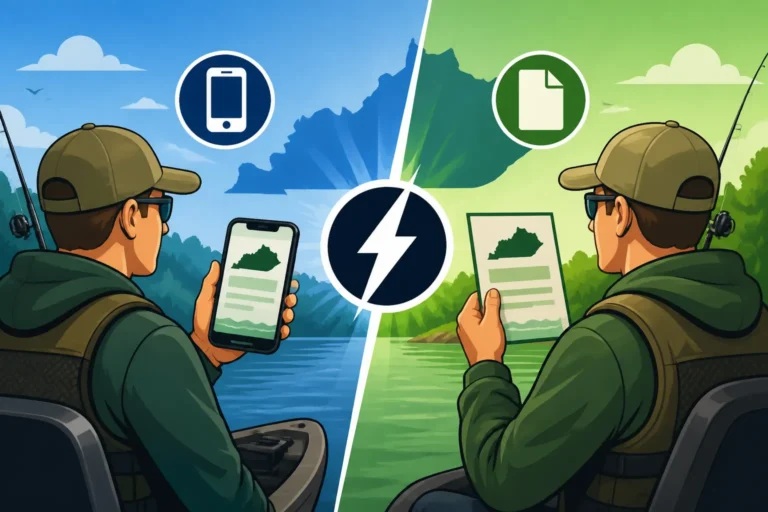
Kentucky generally allows anglers to carry a digital copy of their license on a phone, as well as a printed copy. Many anglers carry both. Phones die, get wet and lose signal, so a printed backup in a waterproof sleeve is never a bad idea. Amazon and most outdoor retailers sell waterproof license holders and dry pouches that keep paper documents safe on the boat.
Gear Worth Packing for Kentucky Waters
While you are budgeting for your license, think about the gear that will make your trip worthwhile. Crappie anglers headed to Kentucky Lake and Lake Barkley often bring light jigging rods, small jigs and minnows. Bass anglers may want a mix of crankbaits, soft plastics and topwater lures. Trout anglers headed to the Cumberland tailwater should pack light spinning gear or a fly rod and a few small spinners and nymphs.
If you are short on gear, ordering a basic tackle assortment from Amazon before the trip can save you a stop at a crowded bait shop on a Saturday morning. Local shops near the lakes are still worth a visit for advice on what is biting. Polarized sunglasses are the other item I never travel without, whether I grab a pair locally or order them on Amazon ahead of time, because they make spotting stumps, brush piles and cruising fish far easier on the big reservoirs.
If a Conservation Officer Checks You
Getting checked on the water is a normal part of fishing, and it is usually quick and friendly if your paperwork is in order. The officer will typically ask to see your license, and may check your catch for size and creel limits. Have your license ready, digital or printed, along with your trout permit if you are fishing trout water.
If you lose your license during a trip, you can usually reprint it or pull it up again through your online account. For the steps, see What to Do If You Lose Your Kentucky Fishing License. It is much easier to fix that before you launch than to explain it after.
Common Mistakes Nonresidents Make
- Buying an annual license in January, only to have it expire at the end of February.
- Forgetting the trout permit when fishing a tailwater where trout are common.
- Assuming a Tennessee license covers every part of Kentucky Lake and Lake Barkley.
- Buying two 7-day licenses when the annual would have been cheaper.
- Not carrying the license, digital or printed, while fishing.
Final Thoughts
The nonresident annual fishing license in Kentucky costs $58.14, and for any out-of-state angler planning more than one trip or more than three separate days on the water, it is usually the best value. Add a $10.57 trout permit if you plan to chase trout, and keep an eye on the March 1 license year start so you get the most from your purchase.
Kentucky offers some of the best fishing in the region, from the crappie flats of Kentucky Lake to the trout tailwaters of the Cumberland. Getting the license right is a small step that makes everything else about the trip easier.
Disclaimer
This article is for general informational purposes only and does not constitute professional advice. Laws, prices and regulations vary by location and change over time. Consult a qualified professional for guidance on your specific situation.