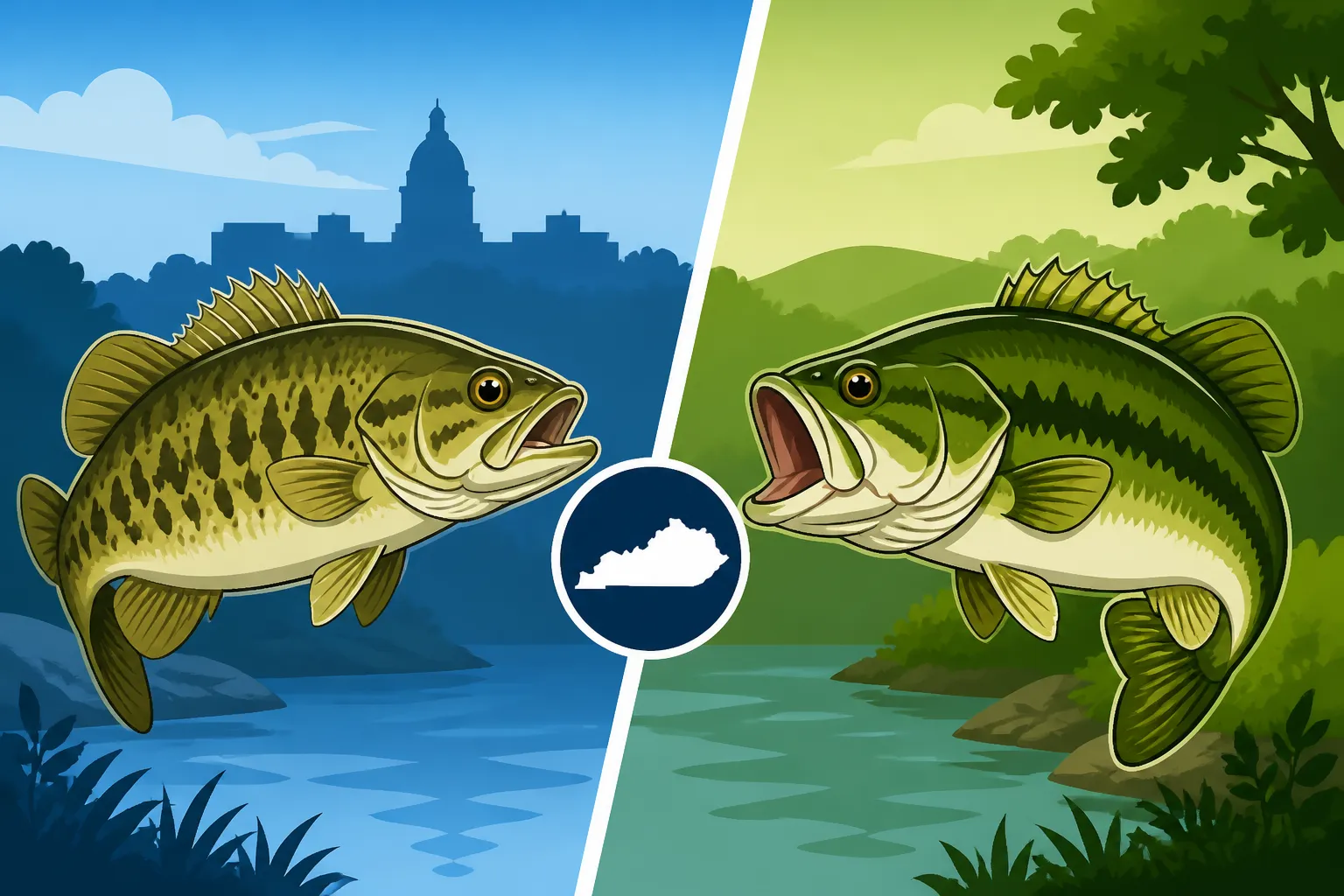
Spotted Bass Vs Largemouth Bass: How to Tell Them Apart
It can be incredibly frustrating to be out on the water, reeling in what you think is a nice largemouth, only to later wonder if it was actually a spotted bass. These two species share so many similarities in appearance and habitat that distinguishing them can feel like a real head-scratcher, even for seasoned anglers. This guide will cut through the confusion, offering clear, practical tips to help you confidently tell the difference between a spotted bass and a largemouth bass the next time you're fishing Kentucky's beautiful waters.
The Tale of Two Bass: Why the Confusion?
Kentucky is blessed with incredible bass fishing, and two of its most popular residents, the largemouth bass and the spotted bass, often cause a bit of a mix-up for anglers. On first glance, they look remarkably alike, sporting similar dark green patterns, sleek bodies, and that unmistakable predatory gleam in their eyes. You might pull one from a brush pile in Lake Cumberland, then another from a rocky point, and assume they're all largemouth. But if you're not paying close attention, you could easily be mistaking one for the other, which can impact how you fish and even what you keep.
Shared Habitats and Similar Appearances
Both largemouth and spotted bass thrive in many of the same Kentucky waterways. You'll find largemouth in just about every lake and pond, often lurking in the thick cover of lily pads, submerged timber, or weed beds. Spotted bass, while also found in lakes, tend to favor clearer, rockier areas and flowages, making them common in rivers and the lower sections of reservoirs. This overlap means that it's entirely possible to catch both species from the same stretch of water on a single outing. Imagine casting to a submerged tree, pulling out a fish, and then moving to a rocky bank nearby and catching another. Unless you know the subtle differences, they might just look like "bass" to your excited eyes.
Their overall body shape and coloration also contribute to the confusion. Both have that classic olive-green to dark-green back, fading to lighter sides with a distinct lateral line, and a whitish belly. They both possess a large mouth (hence the "largemouth" name, which can be deceiving when a spotted bass also has a pretty substantial maw). It’s not uncommon for new anglers, or even experienced ones fishing a new lake, to simply lump them together. This similarity in appearance and shared real estate is the primary reason why so many of us struggle with accurate identification. It’s a classic case of mistaken identity in the aquatic world!
The Frustration of Misidentification
It’s genuinely frustrating when you’re trying to follow regulations, perhaps adhering to a specific size or creel limit for largemouth bass, and you're not entirely sure what you just landed. You might have a mental image of a trophy largemouth, only to find out later that the fish you kept was actually a spotted bass, which often grow to a smaller average size. This can lead to doubts about your catch and, more importantly, can lead to inadvertently violating fishing regulations if you're not careful. Imagine coming home with a cooler full of what you believe are legal fish, only to have a friend point out they're actually a different species with different rules.
Beyond the regulations, misidentification can also hinder your fishing success. These two bass, despite their similarities, do have slightly different behaviors and preferred forage. If you're consistently catching "bass" in areas where spotted bass typically dominate, but you're using largemouth-specific techniques or lures, you might be missing out on opportunities to optimize your approach. Understanding which species you’re targeting, or more accurately, which species you just caught, allows you to refine your strategies, use the right gear, and become a more effective angler. It's about empowering yourself with knowledge to truly master the waters you fish.
Key Visual Differences: Spotting the "Spotted"
Alright, let's get down to brass tacks. There are a few tried-and-true physical markers that, once you know them, will make telling these two apart much easier. It's all about knowing where to look and what subtle details to pay attention to. Think of it like being a detective, looking for clues!
The Jawline Test: A Definitive Indicator
This is perhaps the most reliable and easiest way to distinguish between a spotted bass and a largemouth bass. Gently close the fish's mouth and look at where the corner of its jaw (the maxillary) extends in relation to its eye.
- Largemouth Bass: On a largemouth, the corner of the jaw will extend beyond the rear margin of the eye. It's a truly "large" mouth, living up to its name.
- Spotted Bass: For a spotted bass, the jaw will typically not extend beyond the rear margin of the eye. It stops roughly in line with the middle or front of the eye, giving it a slightly smaller appearance.
Practice this a few times, and you’ll get the hang of it quickly. It’s a definitive characteristic that rarely lies. This jawline distinction is your first and best clue. Remember, you can often feel this by running your thumb along the jawline while looking at the eye. This is a primary feature often used in How to Identify a Largemouth Bass and How to Identify a Smallmouth Bass by Its Markings.
The Lateral Line: More Than Just a Stripe
Both species have a prominent dark lateral line running down their sides, but the nature of this line offers another clue.
- Largemouth Bass: The lateral line on a largemouth often appears as a continuous, often jagged or irregular, dark stripe. It can sometimes break up into blotches, but generally, it's a pronounced, somewhat uniform band.
- Spotted Bass: The lateral line on a spotted bass is usually more broken, appearing as a series of distinct, often diamond-shaped blotches. Below this lateral line, you'll find horizontal rows of small, dark spots—hence their name! These spots are key and truly differentiate them.
When you're comparing the two side-by-side, the largemouth’s lateral line tends to be more of a dominant feature, while the spotted bass’s lateral line is more of a canvas for its characteristic spots. If you catch a bass with clear, individual spots below its main lateral band, you've likely got a spotted bass.
The "Spotted" Belly: A Clue in Its Name
This is where the spotted bass truly earns its moniker.
- Largemouth Bass: Typically, the belly of a largemouth bass is mostly white or cream-colored, with very few, if any, distinct spots. It's generally clean, transitioning smoothly from the darker sides.
- Spotted Bass: Look at the area below the lateral line and onto the belly. A spotted bass will have noticeable rows of dark spots running along its lower sides and belly. These spots are usually quite clear and organized into distinct rows.
These ventral spots are a dead giveaway. If you’re ever in doubt after checking the jawline, flip the fish over and check its belly. If it looks like someone sprinkled pepper evenly across its lower half, you’re almost certainly holding a spotted bass. This visual check is one of the easiest ways to confirm your initial thoughts.
Dorsal Fin Separation
Another often-overlooked but helpful characteristic is the separation (or lack thereof) in their dorsal fins. All bass species have two dorsal fins, but how connected they are can differ.
- Largemouth Bass: The two dorsal fins on a largemouth bass are almost completely separated by a deep notch. You can often nearly lay a finger across the gap between the spiny front dorsal fin and the softer-rayed rear dorsal fin.
- Spotted Bass: The dorsal fins of a spotted bass are joined, or at most, have a very shallow notch. They appear much more continuous, almost like one long fin with a slight dip in the middle.
While not always as obvious as the jawline or the belly spots, this fin detail can be a useful secondary identifier, especially when combined with the other features. It's a subtle but consistent anatomical difference that further helps you solidify your identification.
Here's a quick comparison table to help you remember the key differences:
| Feature | Largemouth Bass | Spotted Bass |
|---|---|---|
| Jawline (Maxillary) | Extends beyond the rear margin of the eye | Does not extend beyond the rear margin of the eye |
| Lateral Line | Usually a continuous, often jagged dark stripe | Broken into distinct blotches/diamond shapes |
| Belly/Lower Sides | Mostly white/cream, few to no distinct spots | Distinct horizontal rows of dark spots |
| Dorsal Fins | Deep notch, almost completely separated | Joined or very shallow notch, nearly continuous |
| "Tongue Patch" | Absent | Often present (a rough patch on the tongue) |
That "tongue patch" is another good one. If you can get a good, safe look at the fish's tongue, the spotted bass often has a small, rough patch of teeth on its tongue that the largemouth typically lacks. Just be careful when checking!
Behavioral and Habitat Differences
Beyond their physical appearance, largemouth and spotted bass also exhibit some distinct preferences in terms of where they live and how they behave. Understanding these differences can not only help you identify them but also improve your fishing strategy. Knowing Where Spotted Bass Are Commonly Found can save you a lot of time.
Preferred Habitats: Rivers vs. Lakes
While there's overlap, each species generally has a type of environment where they truly shine.
-
Largemouth Bass: These are your classic shallow-water ambush predators. They love heavy cover: think thick weed beds, lily pads, fallen trees, brush piles, and submerged stumps. You'll find them in the fertile, often murkier waters of lakes, ponds, and slow-moving rivers. They’re masters of camouflage, waiting patiently for an unsuspecting baitfish or frog to swim by. If you’re fishing a shallow, vegetated cove in a lake like Kentucky Lake, you’re definitely in prime largemouth territory. Their preference for cover means they often don't venture far from their hiding spots.
-
Spotted Bass: Spotted bass, while present in many lakes, truly thrive in clearer, rockier environments. They often prefer current, making them abundant in rivers, creeks, and the deeper, rocky sections of reservoirs. They’re less tied to heavy vegetation and more inclined to relate to structure like rock piles, bluff walls, ledges, and gravel bottoms. On a river like the Cumberland or in a deeper, clearer lake like Herrington Lake, you're more likely to encounter spotted bass holding tight to rocky points or submerged humps. They're often found deeper than largemouth, especially during the warmer months, as they appreciate the cooler, oxygen-rich water found near current.
Understanding these habitat preferences can give you a leg up. If you're struggling to find bass in a super-vegetated shallow area, perhaps moving to a rocky drop-off will yield more spots. Conversely, if you're targeting largemouth, focus on those dense cover areas.
Fighting Style and Temperament
If you've caught both, you've probably noticed a difference in how they feel on the end of your line.
-
Largemouth Bass: The largemouth is known for its explosive initial strike and powerful, head-shaking jumps. When hooked, they often try to dive into cover, wrapping your line around branches or ripping through weeds. They're powerful, but their fight can sometimes be described as "bulldogging" – short, strong bursts. They're quick to tire after a few good runs and jumps, especially larger ones. Many anglers love the thrill of a largemouth going airborne!
-
Spotted Bass: Spotted bass, especially those in current, are often described as having a more sustained, deep-water fight. They pull hard, stay deep, and are less likely to jump than a largemouth. While they might not have the initial explosive power of a largemouth's jump, they tend to fight longer and harder, often making multiple strong runs. Anglers often comment that a two-pound spotted bass fights like a three-pound largemouth. This tenacious fighting style is one reason why many anglers specifically target spotted bass, finding them incredibly fun to reel in, especially on lighter tackle. They're often the ones surprising you with their strength relative to their size.
Diet and Foraging Habits
Their habitat preferences also influence what they eat and how they hunt.
-
Largemouth Bass: Being ambush predators in cover, largemouth bass have a very diverse diet. They'll eat just about anything that swims or falls into the water: baitfish (shad, bluegill, shiners), frogs, crawfish, lizards, snakes, and even small birds or mammals. Their hunting strategy is often to wait in thick cover and strike quickly when prey passes by. This is why topwater lures, weedless jigs, and soft plastics imitating craws or worms are so effective in their typical haunts. They are opportunistic feeders, taking advantage of whatever food source is abundant and easy to ambush.
-
Spotted Bass: While they also eat baitfish and crawfish, spotted bass tend to be more piscivorous (fish-eating) and often chase down their prey in open water or along rocky structures. They are excellent at feeding on schools of baitfish in deeper water or in current. This makes them particularly susceptible to lures that imitate schooling bait, such as crankbaits, jerkbaits, and small swimbaits. They're also known to feed heavily on small crustaceans and insects found in rocky areas. When fishing for spots, you might find success by "fishing the bait" – looking for schools of shad or other forage fish, as the spots will likely be nearby, actively chasing them. This behavior makes them a great target for covering water with moving baits.
Why Accurate Identification Matters
Beyond satisfying your angler curiosity, there are several very practical reasons why being able to correctly identify a spotted bass from a largemouth bass is important. It directly impacts your compliance with regulations, your fishing success, and your contribution to healthy fisheries.
Understanding Fishing Regulations
This is probably the most critical reason for accurate identification. Kentucky's fishing regulations, which you can easily find on the Kentucky Department of Fish and Wildlife Resources website or by checking their annual fishing guide (it's always good to have a Kentucky Fishing Regulations Explained guide handy!), often have different size and creel limits for different bass species. For example, a lake might have a 12-inch minimum length limit for largemouth bass and a daily creel limit of six fish, but a "no length limit" and a different daily creel for spotted bass. If you're mixing them up, you could unknowingly keep an undersized largemouth or exceed your limit for a particular species.
This isn't just about avoiding a ticket; it's about responsible angling. These regulations are put in place by biologists to manage fish populations, ensure sustainability, and maintain healthy fisheries for everyone. By accurately identifying your catch, you're doing your part to respect these conservation efforts. Make sure to check the specific regulations for the body of water you're fishing, as limits can vary not just by species, but also by lake or river section. Kentucky Statewide Bass Size and Daily Limit Rules is a great reference, but always double-check site-specific rules.
Improving Your Fishing Techniques
Knowing which species you're catching or targeting allows you to refine your approach. As we discussed, largemouth prefer cover and ambush tactics, while spotted bass favor rocky structure and often chase bait. If you consistently catch "bass" that turn out to be spotted bass, but you're constantly throwing jigs into lily pads, you might be missing out on opportunities.
By understanding the subtle differences, you can:
- Select the right lures: Use topwater frogs and heavy jigs for largemouth in thick cover, and crankbaits, jerkbaits, or Ned rigs for spotted bass on rocky points.
- Target the right areas: Focus on shallow vegetation for largemouth or deeper, rockier contours for spotted bass.
- Adjust your retrieve: Slower, more deliberate presentations often work for largemouth, while faster, more aggressive retrieves can trigger spotted bass strikes.
Essentially, accurate identification helps you "match the hatch" and "match the habitat." It makes you a more versatile and ultimately more successful angler, allowing you to adapt to the conditions and the specific fish you're trying to fool. Thinking about Best Lures for Spring Fishing or Best Bass Lures for Muddy Water becomes much more effective when you know which bass species you're primarily targeting in those conditions.
Contributing to Conservation Efforts
Every time you correctly identify and report your catch (especially in fishing tournaments or citizen science programs), you're providing valuable data to fisheries biologists. They rely on accurate catch data to monitor fish populations, assess stocking programs, and adjust regulations. If anglers consistently misidentify species, it can skew these data sets, potentially leading to less effective management strategies.
For example, if everyone reports catching largemouth bass when a significant portion are actually spotted bass, the perceived population of largemouth might appear healthier than it truly is, or vice-versa. By taking the time to learn and apply these identification skills, you're actively contributing to the long-term health and sustainability of Kentucky's incredible fishing resources. It's a small effort with a big impact on ensuring that future generations can enjoy the same fantastic bass fishing we do today. You might even find yourself looking up Kentucky Fish Species Guide: 265 Types You Can Catch to learn about all the other cool fish swimming around!
Disclaimer
This article is for general informational purposes only and does not constitute professional advice. Laws, prices and regulations vary by location and change over time. Consult a qualified professional for guidance on your specific situation.