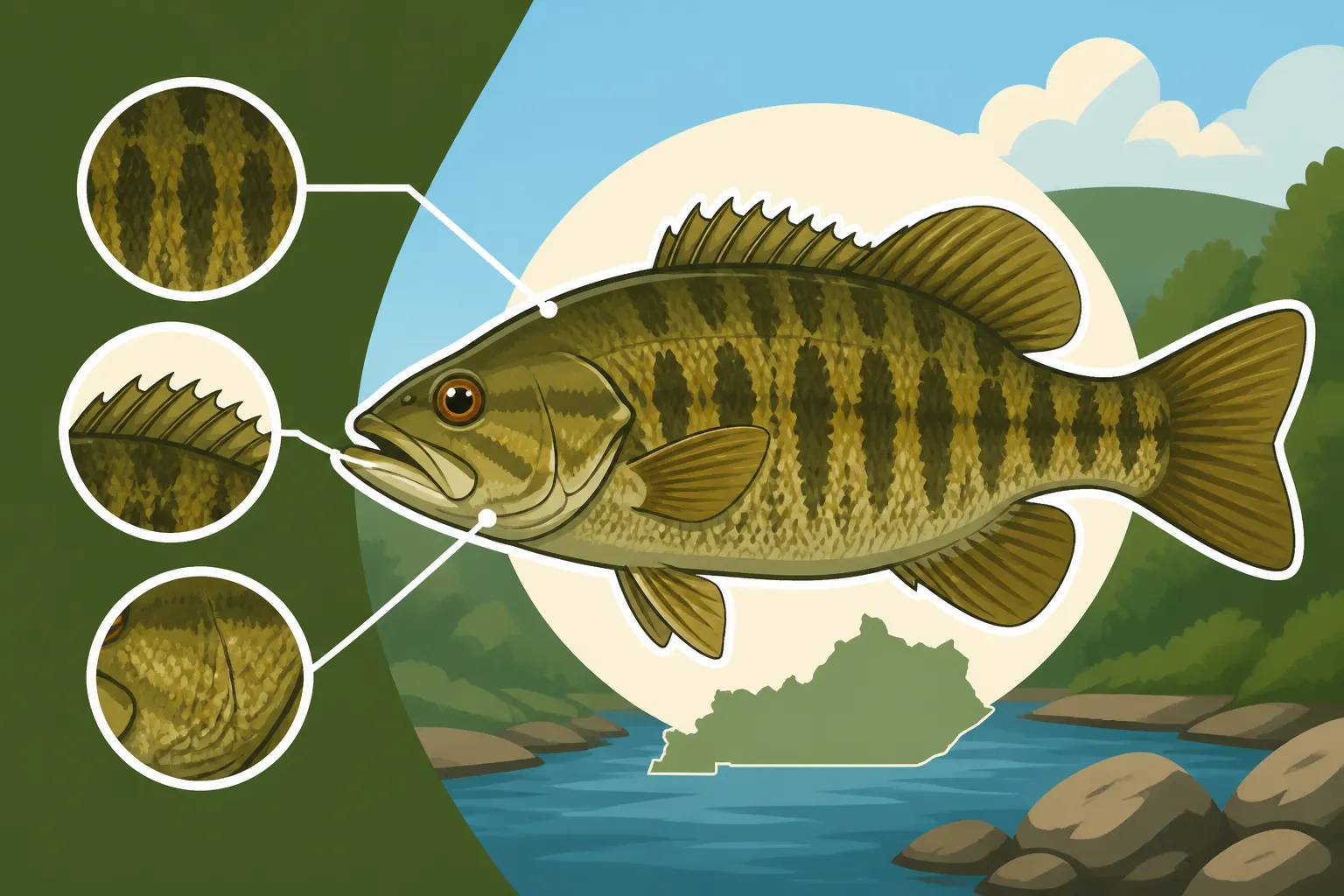
How to Identify a Smallmouth Bass by Its Markings
Trying to tell the difference between a smallmouth bass and its cousins when you're out on the water in Kentucky can be a real head-scratcher. Many anglers, even experienced ones, often find themselves pausing, staring at their latest catch, and wondering if they've got a largemouth, a spotted bass, or that bronze beauty, the smallmouth. This guide is here to clear up that confusion, focusing on the specific markings and physical traits that unequivocally identify a smallmouth bass.
The Distinctive Appearance of a Smallmouth Bass
When you first lay eyes on a smallmouth bass, especially one fresh out of the clear, cool waters they prefer, you'll notice a certain elegance. They're built for speed and fighting power, and their appearance reflects that. But beyond the general impression, there are specific markings that truly give them away.
Overall Body Shape and Coloration
Smallmouth bass typically boast a body that's more streamlined and torpedo-shaped compared to the deeper, more compressed body of a largemouth. Think of them as the athletic sprinters of the bass world. Their coloration is usually a beautiful spectrum of olive, bronze, or brownish-green on their backs, fading into lighter flanks that often have a golden or yellowish hue, and a creamy white belly. This coloring isn't just for show; it's fantastic camouflage in the rocky, often clear-water environments they inhabit. You'll find that their specific shades can vary quite a bit depending on the water clarity, bottom composition, and even their diet in a particular lake or river. A smallmouth from a dark, tannic river might appear much darker than one from a clear, rocky reservoir like Dale Hollow. This adaptable coloring is one reason why relying solely on general color can sometimes be misleading, but it's a good starting point for a general identification.
Imagine you've just landed a fish near the rocky shoals of Lake Cumberland. Its back might be a rich, dark bronze, almost blending perfectly with the submerged rocks and gravel. As you bring it closer, you see that the bronze transitions smoothly to a lighter, almost golden side, with a clean white underside. This subtle shift in color, without dramatic blotches or lines along the lateral line, is a classic smallmouth characteristic. This robust build allows them to fight with incredible vigor, making them a favorite among anglers seeking a challenging catch.
Key Markings: Vertical Bars and Darker Blotches
Now, let's talk about the real tell-tale signs: the markings. Smallmouth bass typically display 8 to 16 irregular, dusky vertical bars or tiger-like stripes along their sides. These aren't always super distinct or perfectly symmetrical; they can be broken, splotchy, or even appear as a series of darker blotches rather than crisp lines, especially on older or larger fish. The intensity of these markings also varies. On some fish, they might be quite prominent and dark, making them look almost banded. On others, particularly those from very clear water, these markings can be quite faint, almost disappearing into the bronze background.
These vertical bars are a primary characteristic that helps differentiate them from largemouth bass, which tend to have a more prominent, unbroken horizontal lateral line stripe, and spotted bass, which are known for their rows of distinct spots below the lateral line. You might notice these vertical bars are most evident when the fish is first caught or when it's in colder water, as stress or water temperature can sometimes influence their appearance. It's like their mood ring – the markings can become more pronounced when they're excited or agitated.
Consider a smallmouth you've reeled in from the rock piles in the Cumberland River. Instead of a solid line, you'd see several distinct, often wavy or irregular, dark vertical bands running down its flanks. These bands might be darker near the top and fade as they get closer to the belly. This pattern is far less uniform than the lateral stripe of a largemouth, and definitely not the neat rows of spots you'd find on a spotted bass. Learning to recognize these subtle, broken vertical bars is a major step in correctly identifying a smallmouth bass. Many anglers looking for new gear to help them spot these fish underwater often check out options on Amazon for high-quality polarized sunglasses.
Head and Mouth Features for Identification
Beyond the body markings, the head and mouth of a smallmouth bass offer some of the most definitive clues for identification. These features are often less variable than body coloration or bar intensity, making them extremely reliable.
Jawline and Mouth Size
This is arguably the most crucial identifying feature for a smallmouth bass, especially when comparing it to a largemouth. Take a close look at the jawline. On a smallmouth bass, when its mouth is closed, the corner of its upper jaw (the maxilla) will not extend beyond the back edge of its eye. It typically stops right in line with the middle of the eye, or even before it. This gives the smallmouth its "small mouth" appearance, hence the name.
Contrast this with a largemouth bass, where the jawline extends noticeably beyond the back edge of the eye, sometimes significantly. It's a quick, easy visual check that can instantly clarify your catch. Even on a big, trophy smallmouth, that jaw will still remain relatively short compared to its larger-mouthed relatives. This anatomical difference is adapted to their feeding habits; smallmouth tend to feed on smaller prey like crayfish and minnows, whereas largemouth are capable of gulping down much larger meals.
If you're ever in doubt, gently close the fish's mouth and use your thumb or a straight edge to align with the back of its eye. If the jaw stays within that boundary, you've got a smallmouth. This simple trick can save you from misidentifying your catch and ensure you're following the correct Kentucky Statewide Bass Size and Daily Limit Rules for the fish you've caught.
Eye Color and Characteristics
While not as definitive as the jawline, the eye of a smallmouth bass also offers some subtle clues. Smallmouth bass often have eyes that are reddish-brown, reddish-orange, or even amber in color, sometimes with a distinctive horizontal stripe through the pupil. This color often complements their bronze body tones, giving them a fierce, alert look.
The eyes are typically relatively large in proportion to their head, which is an adaptation for their clear-water habitat and reliance on sight for hunting prey. While a largemouth's eyes might be a more standard dark or black, and a spotted bass's eyes can be quite similar to a smallmouth, the combination of eye color with the jawline and body markings creates a more complete picture. Keep in mind that like body coloration, eye color can have slight variations based on genetics and environmental factors, but the tendency towards a reddish hue is a fairly consistent trait for smallmouth bass across Kentucky waters.
For instance, if you're fishing a clear, rocky stream, you might notice the smallmouth bass you catch have especially vivid red eyes, almost glowing in the sunlight. This striking feature, combined with those broken vertical bars, often cements the identification even before you check the jawline.
Fin and Tail Characteristics
The fins and tail of a smallmouth bass, while perhaps less distinctive than the jaw, still contribute to its overall identification profile. They reflect the fish's active, hard-fighting nature and are worth noting for a complete assessment.
Dorsal Fins: Spiny vs. Soft
Like all members of the Micropterus genus (the black bass family), smallmouth bass have two dorsal fins that are broadly connected, appearing almost as one long fin with a shallow notch in the middle. The front part of this dorsal fin is spiny, containing 9 to 11 sharp rays. The rear portion is soft-rayed, typically with 13 to 15 soft rays. What's important here is that these two sections are connected, albeit with a noticeable dip or notch between them.
This continuous dorsal fin is a common characteristic among black bass, so it's not a sole identifier for smallmouth. However, the overall shape and the depth of the notch can sometimes provide subtle hints, particularly if you're accustomed to seeing how distinct the two dorsal fins can be on other species. In smallmouth, this connection is usually more pronounced than the more deeply separated dorsal fins you might see on some other fish species. Understanding the standard fin ray counts can be helpful for those who really want to get into the minutiae of fish identification.
When you hold a smallmouth, run your finger gently along the top of its back. You'll feel the sharp spines of the anterior dorsal fin, and then a slight depression before the softer rays of the posterior dorsal fin begin. This connected structure is consistent, and while not unique to smallmouth, it's a solid part of their anatomical blueprint.
Caudal Fin (Tail) and Pectoral Fins
The caudal fin, or tail, of a smallmouth bass is typically moderately forked. It's not deeply split like some other fish, but it definitely has a distinct V-shape. The color of the tail often matches the body, usually being dusky or brownish, sometimes with a faint darker band near the edge, especially in younger fish. The pectoral fins (the pair of fins behind the gill covers) are generally translucent or slightly yellowish, relatively short, and rounded.
The anal fin (the single fin on the underside near the tail) and pelvic fins (the pair on the underside closer to the head) also tend to be dusky or brownish, matching the overall body coloration. There are no exceptionally bright colors or unique patterns on the fins that would immediately set them apart from other bass species. Their fin characteristics are more about what they lack – flashy colors or unusual shapes – rather than a truly unique identifying mark.
For anglers keen on observing every detail, you might notice that the fins on a smallmouth often have a somewhat uniform appearance, blending seamlessly with the rest of its sleek, powerful body. There are no dramatic splotches or stark color contrasts, which again, contributes to their excellent camouflage in their preferred habitats. This consistency extends to their powerful tail, which is a major contributor to their famous fighting prowess.
Distinguishing Smallmouth from Similar Species in Kentucky
Kentucky waters are home to a fantastic variety of bass, and while they're all fun to catch, knowing exactly what you've landed is important for understanding regulations and simply satisfying your angler's curiosity. The smallmouth bass has a couple of close relatives in the state that can sometimes lead to confusion.
Smallmouth vs. Largemouth Bass
This is probably the most common identification challenge. While they're both "black bass," their differences are quite distinct once you know what to look for.
The largemouth bass (as its name suggests) has a much larger mouth. When its mouth is closed, the corner of its upper jaw extends well beyond the back edge of its eye. This is the single easiest differentiator. In terms of body shape, largemouths are typically deeper-bodied and more stout, often described as having a "football" shape compared to the smallmouth's streamlined "torpedo." Coloration for largemouths is usually a darker green to olive, with a prominent, often solid, horizontal dark stripe running along its lateral line from gill plate to tail. This lateral stripe is very distinct and rarely broken. How to Identify a Largemouth Bass provides even more detailed comparison points.
So, when you're looking at your catch:
- Jawline: Smallmouth's jaw stops at or before the back of the eye; Largemouth's jaw extends well past the eye.
- Body Markings: Smallmouth has irregular vertical bars/blotches; Largemouth has a distinct horizontal lateral stripe.
- Body Shape: Smallmouth is more streamlined; Largemouth is deeper-bodied.
These three points will almost always give you the correct answer. You can also feel their dorsal fins; while both are connected, the largemouth often has a slightly deeper notch, but this is less reliable than the jaw.
Smallmouth vs. Spotted Bass
The spotted bass (Micropterus punctulatus) is another common species in Kentucky that can sometimes be mistaken for a smallmouth, especially smaller ones. They share some similarities in body shape and general coloration, but key differences exist.
The most obvious clue for a spotted bass is its name: they have rows of distinct, dark spots along their lower sides, below the lateral line. These spots are usually arranged in neat, almost diamond-shaped rows. Unlike the smallmouth's vertical bars, these are very clearly spots. Another critical identifier for spotted bass is a small patch of teeth on their tongue, which you can feel with your finger. Neither smallmouth nor largemouth bass possess this tongue patch.
The jawline of a spotted bass is intermediate between a smallmouth and a largemouth. It typically extends to about the middle of the eye or slightly beyond, but generally not as far back as a largemouth's. Their overall body shape is also somewhat intermediate, often more streamlined than a largemouth but not quite as robust as a true smallmouth.
Here's the breakdown for differentiating a smallmouth from a spotted bass:
- Body Markings: Smallmouth has irregular vertical bars/blotches; Spotted bass has distinct rows of spots below the lateral line.
- Tongue Patch: Smallmouth lacks a tongue patch; Spotted bass has a small patch of teeth on its tongue.
- Jawline: Smallmouth's jaw stops at or before the back of the eye; Spotted bass's jaw extends to the middle or slightly beyond, but not usually as far as a largemouth.
Understanding these subtle distinctions is crucial, especially since regulations for Kentucky Statewide Bass Limit: 12 Inches, 6 Fish a Day can apply differently to various bass species in certain waters.
Here's a quick reference table to help visualize these differences:
| Feature | Smallmouth Bass | Largemouth Bass | Spotted Bass |
|---|---|---|---|
| Jawline | Does not extend past the back of the eye. | Extends well past the back of the eye. | Extends to middle or slightly past the eye. |
| Body Shape | Streamlined, torpedo-shaped, less deep. | Deep-bodied, stout, "football" shape. | Intermediate, somewhat slender. |
| Body Markings | Irregular vertical bars or blotches. | Prominent, unbroken horizontal lateral stripe. | Rows of distinct dark spots below the lateral line. |
| Tongue | Smooth, no tooth patch. | Smooth, no tooth patch. | Small patch of teeth on tongue (feel with finger). |
| Dorsal Fins | Connected with a shallow notch. | Connected with a deep notch (almost separated). | Connected with a shallow notch. |
| Coloration | Bronze, olive, brown with lighter belly. | Dark green to olive with lighter belly. | Olive to gray-green with lighter belly. |
| Habitat | Clear, cool, rocky water (rivers, reservoirs). | Weedy, warm, murkier water (lakes, ponds). | Rivers and clear reservoirs, often deeper. |
When you're out fishing, don't just rush to release your catch. Take a moment to observe these features. It's a great way to learn more about the fish you're targeting and become a more knowledgeable angler. Getting good at this identification will serve you well, whether you're chasing them in the Cumberland River or on the sprawling waters of Kentucky Lake. Remember, knowing your fish helps you adhere to local regulations and contribute to sustainable fishing practices in Kentucky.
Disclaimer
This article is for general informational purposes only and does not constitute professional advice. Laws, prices and regulations vary by location and change over time. Consult a qualified professional for guidance on your specific situation.