Muskie Vs Northern Pike: Key Differences
It's a common scenario in Kentucky: you're out on the water, you hook into something big with a mouth full of teeth, and your first thought is, "Is this a muskie or a northern pike?" For many anglers, especially those new to pursuing these formidable predators, the distinction can be incredibly fuzzy. This guide is here to clear up that confusion, diving deep into the key differences between muskellunge (muskie) and northern pike, helping you identify your catch with confidence and better understand their unique characteristics in Kentucky waters.
The Tale of Two Toothies: Understanding the Basics
Kentucky's waterways are home to a diverse array of fish, and among the most sought-after by trophy anglers are the muskie and, to a lesser extent, the northern pike. Both are long, cylindrical, predatory fish with sharp teeth, and both can give you a heart-stopping fight. It’s easy to see why they’re often confused. But once you know what to look for, these differences become clear, not just in their appearance but also in their behavior and preferred habitats. Understanding these nuances is key to becoming a more informed and successful angler in the Bluegrass State.
Muskie: The Apex Predator of Kentucky's Lakes
The muskellunge, or muskie, holds a legendary status among freshwater anglers. Often called the "fish of 10,000 casts," it's renowned for its elusive nature and explosive power. In Kentucky, muskie are primarily found in specific large reservoirs and river systems that offer the deep, clear, often cover-rich environments they prefer. Think places like Cave Run Lake in Eastern Kentucky, which is famous for its muskie fishery. These fish are true apex predators, growing to impressive sizes, with some specimens exceeding 50 inches and weighing over 40 pounds. Their diet consists almost entirely of other fish, making them a significant part of the aquatic food chain.
Muskies typically have a more solitary existence than their pike cousins, often ambushing prey from dense cover or suspended structure. Their sheer size and aggressive strikes make them a thrilling challenge for any angler. Catching one often requires immense patience, specialized gear, and a solid understanding of their habits. When you finally connect with one, prepare for a battle that tests your tackle and your resolve. These fish are survivors, and every muskie landed in Kentucky is a testament to an angler's dedication. If you're looking for where to target these giants, our guide on Kentucky's Best Lakes for Muskie Fishing can point you in the right direction.
Northern Pike: A Less Common but Still Formidable Foe
While muskie are relatively well-established in specific Kentucky fisheries, northern pike are far less common across the state. They typically thrive in cooler, shallower waters with abundant vegetation, often found more frequently in northern states and Canada. When encountered in Kentucky, they might be in certain impoundments or river backwaters where conditions are suitable. Northern pike are also formidable predators, known for their aggressive strikes and torpedo-like runs. They may not reach the gargantuan sizes of some muskie, but a large pike is still a significant catch, often growing to lengths of 20-30 inches, and sometimes larger.
Northern pike tend to be a bit more opportunistic feeders than muskie, often preying on a wider variety of fish, frogs, and even small mammals or birds that venture too close to the water's edge. Their aggressive nature means they can be a bit easier to provoke into striking than the notoriously finicky muskie, though they still offer a thrilling fight. For anglers accustomed to other freshwater species, encountering a northern pike in Kentucky can be a delightful surprise, showcasing the state's diverse aquatic life. However, due to their scarcity, dedicated pike fishing trips are not as common in Kentucky as muskie expeditions, making any pike catch a special event.
Spotting the Differences: Identification Marks and Morphology
Alright, let's get down to brass tacks: how do you actually tell these two fish apart when they're flopping in your net, or better yet, before you even land them? The key lies in a few distinct physical characteristics that, once you know them, make identification much simpler. Forget trying to guess by general size or color alone; those can be misleading. Focus on these specific anatomical markers.
Head and Cheek Scales: The Easiest Tell-Tale Signs
This is hands down the most reliable way to distinguish a muskie from a northern pike. You need to look at the gill cover (operculum) and the cheek area directly behind the eye.
- Muskie: A true muskellunge will have scales only on the upper half of its gill cover and cheek. The lower half of both areas will be bare, without scales. Imagine a vertical line down the middle of the gill plate and cheek; the scales stop halfway down.
- Northern Pike: In contrast, a northern pike has scales covering its entire cheek, but only the upper half of its gill cover. So, its gill cover is similar to a muskie's, but its cheek is fully scaled.
This scale pattern is a biological constant and won't change with the fish's age, size, or specific habitat. If you're unsure, gently lift the gill cover and feel or look closely at the cheek and operculum. A quick online search or a good field guide (many comprehensive fishing guides are available on Amazon for Kentucky or regional species) can provide clear diagrams to help solidify your understanding. Taking a moment to verify this can save you from misidentifying a rare catch.
Body Markings and Coloration: More Than Just Spots
While the scale patterns are definitive, body markings can offer strong clues, though they can sometimes be variable.
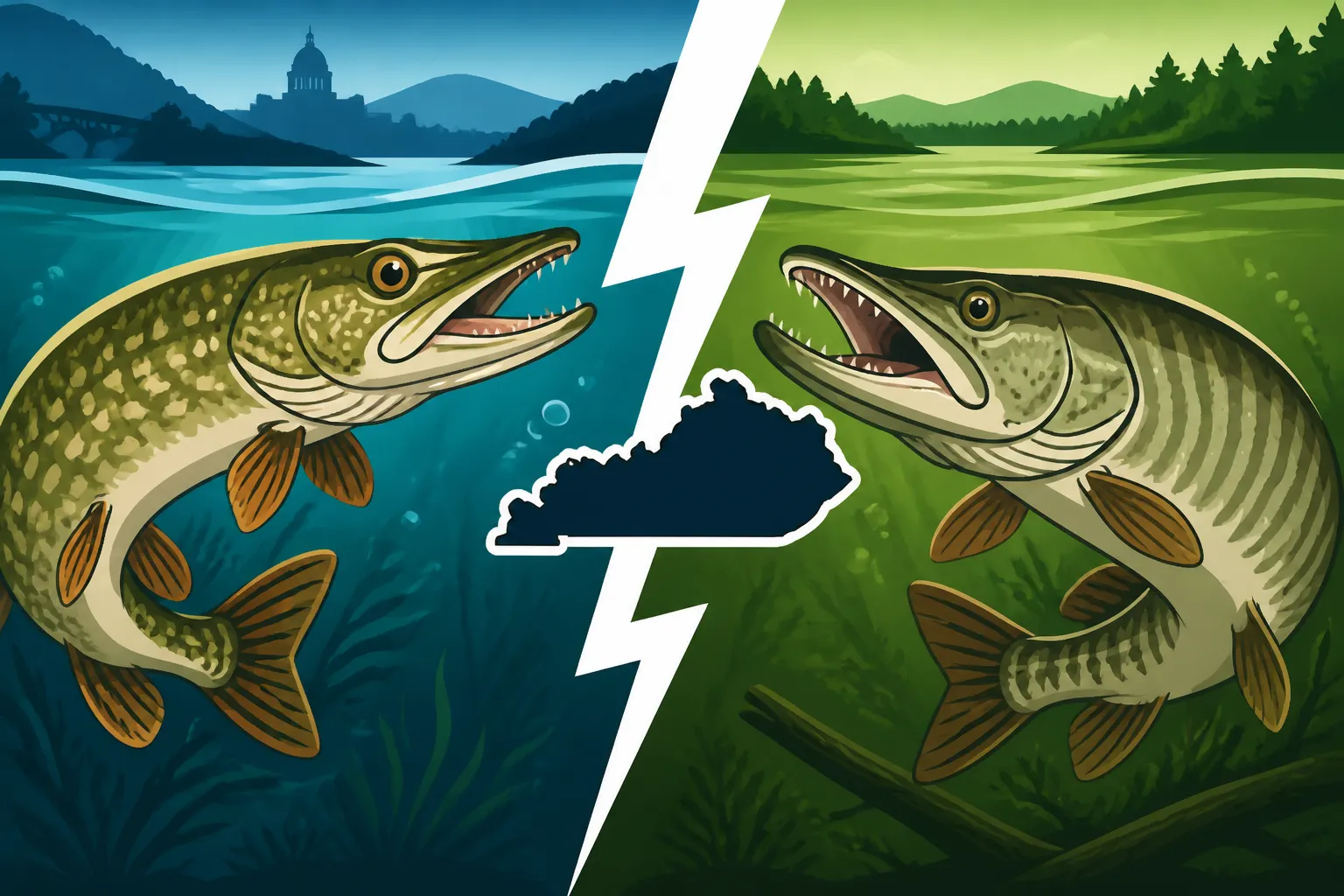
- Muskie: Muskies generally have darker markings on a lighter body background. These markings can appear as distinct spots, bars, or even vertical stripes. The pattern often looks like irregular blotches or vertical bars running down their sides. The base color is usually light (greenish, grayish, or brownish), with the darker patterns overlaid. It's like someone took a brush and painted dark, irregular shapes onto a lighter canvas.
- Northern Pike: Northern pike, conversely, typically have lighter, often yellowish or bean-shaped spots on a darker body background. Their overall body color tends to be a darker green or olive, and the spots are distinct, often forming horizontal rows or irregular patterns. Think of it as light spots scattered across a dark, olive-green base.
It's important to remember that coloration can be influenced by water clarity, diet, and even genetics within a specific body of water. A muskie from a clear, rocky lake might look slightly different from one caught in stained, weedy waters. However, the type of marking (dark on light vs. light on dark) and their general shape usually remain consistent.
Tail Fin Shape and Jaw Structure: Subtle But Significant
Beyond scales and coloration, there are a couple of other, albeit more subtle, features you can observe.
- Tail Fin: While both species have forked tails, the muskie's tail tends to be more deeply forked and pointed, almost like a "W" shape. The northern pike's tail, while still forked, is often more rounded or less deeply indented, resembling more of a "V" shape. This difference can be harder to discern quickly, especially on a struggling fish, but it's another piece of the puzzle.
- Jaw Structure: Both have duck-bill shaped mouths full of razor-sharp teeth. However, muskie typically have more pores on the underside of their lower jaw compared to northern pike. Muskies usually have 6-9 pores on each side, while northern pike generally have 5 or fewer. Counting these tiny pores can be tricky and isn't always practical when you're trying to quickly release a fish, but it's a definitive scientific marker. Also, the overall head shape can sometimes appear slightly more elongated and pointed on a muskie compared to a pike, but this is a very subjective observation.
Here's a quick comparison table to help you keep these distinctions straight:
| Feature | Muskellunge (Muskie) | Northern Pike |
|---|---|---|
| Cheek Scales | Scaled only on the upper half | Fully scaled |
| Gill Cover Scales | Scaled only on the upper half | Scaled only on the upper half |
| Body Markings | Dark spots or bars on a lighter background | Light (often yellowish) spots on a darker background |
| Tail Fin | More deeply forked and pointed ("W" shape) | Less deeply forked, often more rounded ("V" shape) |
| Lower Jaw Pores | 6-9 pores on each side | 5 or fewer pores on each side |
Habitat, Behavior, and Fishing Implications
Understanding the physical differences is vital, but knowing where these fish prefer to live and how they behave can also aid in identification and improve your fishing strategy. While there can be overlap, their typical haunts in Kentucky offer clues.
Where You'll Find Them in Kentucky: Preferred Waters
The distribution of muskie and northern pike in Kentucky is quite different, largely dictated by their environmental needs.
- Muskie: In Kentucky, muskie are primarily found in larger, cooler reservoirs and associated river systems. Iconic muskie fisheries like Cave Run Lake, as well as portions of the Kentucky River and Green River, are prime examples. These waters often have deep main channels, significant amounts of submerged timber, rock ledges, and distinct thermoclines that provide the cooler, oxygenated water muskie prefer. They are often associated with larger structure and open water, though they will utilize shallow cover for ambushing prey. Anglers targeting muskie often look for deep weed lines, points, and channel swings. You can find more detailed information in our guide, Muskie, Pike and Pickerel Fishing in Kentucky.
- Northern Pike: Northern pike are much less common and widespread in Kentucky. While some isolated populations might exist in certain impoundments or cooler river sections, they are not typically targeted as a primary sportfish across the state in the way muskie are. If encountered, they are more likely to be in shallower, weedier bays, backwaters, or cooler feeder creeks, preferring environments with dense aquatic vegetation where they can hide and ambush prey. These are the kinds of spots where, historically, northern pike have thrived in more northerly climates. Their presence in Kentucky is often an anomaly rather than a consistent fishery.
Given this, if you're fishing in a renowned muskie lake, the odds are overwhelmingly in favor of your toothy catch being a muskie. If you're in a smaller, weedier, less-publicized waterbody, a northern pike might be a possibility, but a muskie is still more likely to be the targeted or accidental catch of a similar species.
Fight Style and Angling Challenges
Both muskie and northern pike are celebrated for their fighting prowess, but there are some nuances in how they battle once hooked.
- Muskie: A muskie strike is often described as a freight train hitting your lure. They are known for powerful, head-shaking runs, often accompanied by spectacular aerial jumps. Their fights are characterized by bursts of incredible strength and endurance. They have a reputation for being incredibly difficult to land, often making last-second dives or violent thrashing at the boat. The "fish of 10,000 casts" moniker extends to the fight itself; even after hooking one, getting it to the net is a significant challenge. Specialized gear, including heavy-duty rods, stout reels, and strong lines, is essential. For appropriate gear, check out Best Rods and Reels for Kentucky Fishing or browse a wide selection of heavy-duty tackle on Amazon.
- Northern Pike: Northern pike also strike with impressive force and offer a thrilling fight. They are known for powerful initial runs, often peeling line off the reel. While they can jump, they are perhaps more known for their aggressive head shakes and powerful, bulldogging dives. Their fight is typically intense but might not have the same prolonged endurance or the multiple, explosive runs that a large muskie can exhibit. However, a big pike will certainly test your drag and your knot strength. They are still an incredible sportfish and require careful handling due to their sharp teeth and powerful bodies.
Regardless of which species you hook, a stout leader (steel or heavy fluorocarbon) is absolutely non-negotiable to prevent their razor-sharp teeth from cutting your line. Always have a large, deep net and long-nose pliers or jaw spreaders ready for safe handling and release.
Hybrid Confusion: The Saugeye and Tiger Muskie
Adding another layer of potential confusion, nature sometimes throws us curveballs in the form of hybrids. In Kentucky, anglers might occasionally encounter a "saugeye" (a hybrid of walleye and sauger) or, more relevant to our topic, a "tiger muskie."
- Tiger Muskie: A tiger muskie is a sterile hybrid cross between a muskellunge and a northern pike. These fish exhibit characteristics of both parents, often displaying a distinctive "tiger-striped" pattern of dark, wavy, irregular vertical bars or blotches on a lighter background, hence their name. Their scale patterns on the cheek and gill cover can also be intermediate, sometimes making definitive identification tricky without a very close look. While they are not as common as true muskie in Kentucky, they are occasionally stocked in certain waters or can occur naturally where both parent species exist. If you catch a fish that looks like a muskie but has pronounced, almost cartoon-like vertical stripes, it's very likely a tiger muskie. We have more information on this specific hybrid in our article, Is Tiger Muskie a Cross Between Muskie and Northern Pike?.
- Other Hybrids: While saugeye are a different category entirely, the existence of hybrids underscores the importance of learning the definitive identification markers. It's easy to jump to conclusions based on general appearance, but the scale count is rarely wrong. These hybrid forms often grow quite large and offer exciting angling opportunities, but their presence also highlights why accurate species identification is so important for management and regulation.
Conservation and Regulations: Why Identification Matters
Beyond the thrill of the catch and the satisfaction of knowing what you've landed, accurately identifying muskie and northern pike has real-world implications, particularly regarding conservation and fishing regulations. Kentucky's fisheries are carefully managed, and understanding the rules for each species is part of being a responsible angler.
Size and Bag Limits: Knowing Your Catch is Crucial
The Kentucky Department of Fish and Wildlife Resources (KDFWR) implements specific regulations to manage fish populations and ensure sustainable angling for future generations. These regulations often differ between species.
- Species-Specific Rules: Muskie and northern pike, being distinct species, may have different size limits, daily creel limits (bag limits), and even specific seasons in certain waters. For example, a trophy muskie fishery might have a very high minimum size limit (e.g., 40 inches or more) and a low daily limit (e.g., one fish per person) to protect the breeding stock and encourage the growth of truly large specimens. If you misidentify a northern pike as a muskie (or vice-versa) and keep it, you could inadvertently violate these regulations.
- Checking Current Regulations: Before every fishing trip, it is absolutely essential to consult the latest KDFWR fishing guide or their official website. Regulations can change from year to year, and they can also vary by specific lake or river. What's legal on Cave Run Lake for muskie might be different from rules on a smaller body of water where a northern pike might be found. Ignorance of the law is never an excuse, and penalties for violations can include fines and loss of fishing privileges. Our comprehensive guide, Kentucky Fishing Regulations Explained, offers a great starting point for understanding the statewide rules, but always double-check site-specific regulations for Statewide Bag and Size Limits by Fish Species.
Taking the time to accurately identify your catch ensures you're complying with the law and contributing to the health of Kentucky's precious fisheries.
Handling and Release: Protecting These Giants
Both muskie and northern pike are ecologically valuable predators, and due to the "catch-and-release" ethic prevalent among anglers targeting these species, proper handling is paramount for their survival.
- Their Vulnerability: These fish are strong, but they are also vulnerable to injury, especially when out of the water. Their large size and powerful bodies can make them difficult to control, and their sharp teeth pose a risk to both the fish and the angler. Misidentifying a fish and not being prepared with the right tools can lead to unnecessary stress or harm to the fish.
- Best Practices for Release:
- Minimize Out-of-Water Time: Keep the fish in the water as much as possible, especially during hook removal and photos.
- Support the Fish's Body: If you must lift the fish, support its entire body horizontally, particularly its belly, to prevent damage to internal organs. Never lift a large muskie or pike vertically by its jaw alone.
- Use Proper Tools: Have a large, rubberized landing net, long-nose pliers (or a hook-out tool), and potentially jaw spreaders or heavy-duty gloves on hand before you even hook a fish. These tools are indispensable for safely removing hooks from their toothy mouths. You can find excellent quality landing nets and fishing tools designed for these larger predators on Amazon.
- Revival: If the fish seems stressed, hold it gently in the water, facing into the current, until it regains strength and can swim away on its own.
By understanding the differences between muskie and northern pike, and by adhering to responsible fishing practices, you play a vital role in ensuring that these incredible fish continue to thrive in Kentucky's waters for generations to come. Your careful identification and mindful handling reflect a deep respect for the resource and the sport.
Disclaimer
This article is for general informational purposes only and does not constitute professional advice. Laws, prices and regulations vary by location and change over time. Consult a qualified professional for guidance on your specific situation.