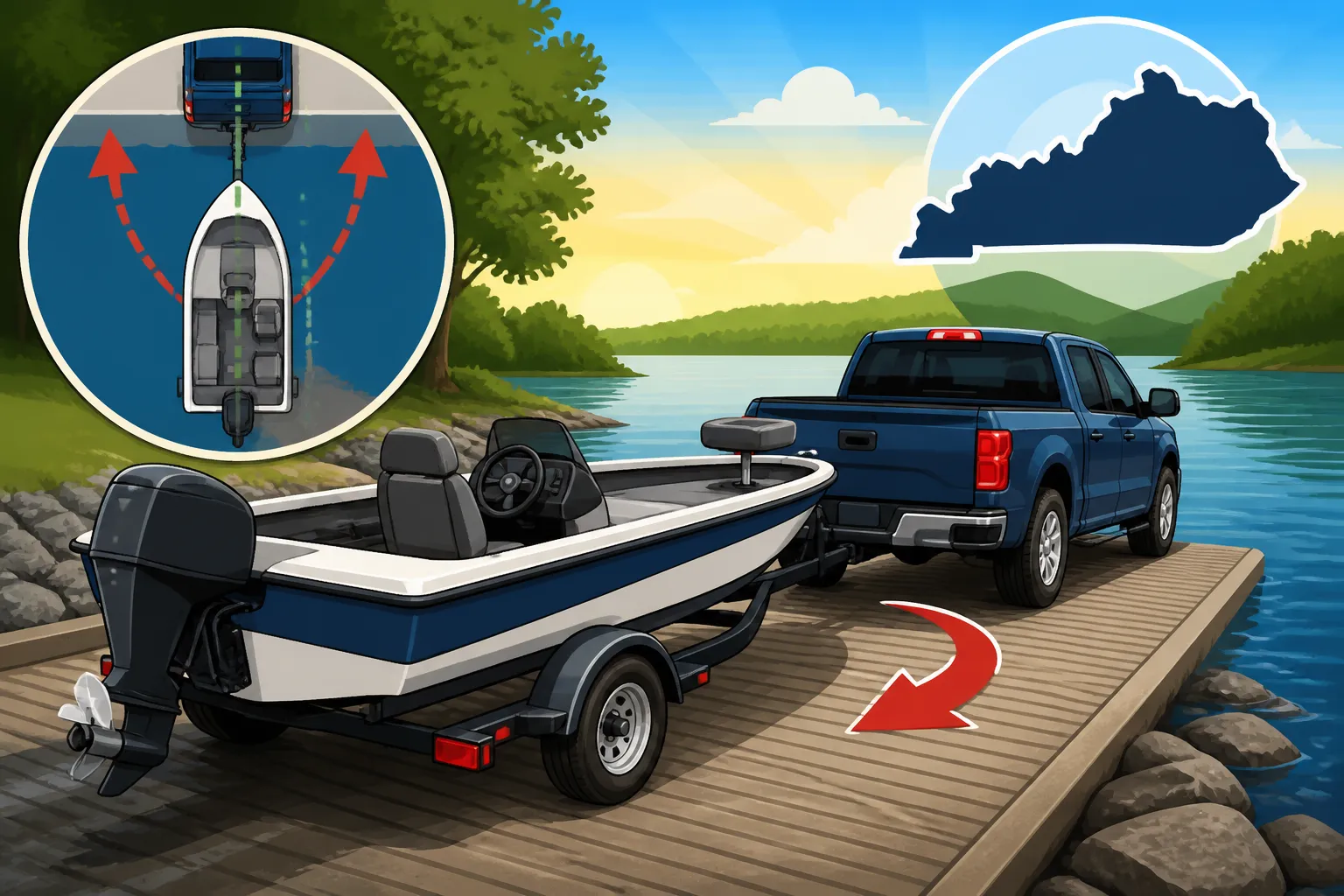
How to Back a Boat Trailer Down a Ramp
We've all been there – pulling up to a busy Kentucky boat ramp on a perfect Saturday morning, heart pounding just a little faster as you eye the narrow lane, the waiting eyes, and that daunting stretch of concrete disappearing into the water. Backing a boat trailer can feel like trying to pat your head and rub your belly while solving a calculus problem backward, especially when it seems like everyone else is a seasoned pro. But it doesn't have to be a source of dread. This guide is here to walk you through the process, demystify the art of trailer backing, and give you the confidence to navigate any ramp with ease, making your next fishing trip less about the parking lot stress and more about the thrill of the catch.
Understanding the Basics of Trailer Physics It's Not as Hard as It Looks
Before you even think about putting your truck in reverse, it helps to understand why a trailer behaves the way it does. It’s counter-intuitive at first, and that's precisely why so many of us struggle. Once you grasp the core principles, the movements start to make a lot more sense, and you'll realize it's less about magic and more about a predictable dance between your tow vehicle and the trailer.
The Counter-Intuitive Steering Rule Where Does the Trailer Go?
This is the biggest hurdle for most beginners, and honestly, even experienced folks can get flustered. When you're backing up a car alone, you turn the wheel left, and the back of the car goes left. Simple. But with a trailer, if you turn your steering wheel to the left, the rear of your car moves to the left, which in turn pushes the front of your trailer to the left, causing the rear of the trailer to swing to the right. Yes, you read that right – to make the back of your trailer go left, you actually need to turn your steering wheel to the right. It's like a reverse logic puzzle.
Think of it this way: your tow vehicle is essentially pushing the trailer from its hitch point. Whatever direction the back of your truck pushes the hitch, the front of the trailer will follow, and the back of the trailer will swing in the opposite direction. Mastering this takes a bit of mental rewiring, but once it clicks, you'll find yourself making smaller, more deliberate steering inputs rather than frantic, over-correcting jerks. Patience and a clear understanding of this principle are your best friends here.
Pivot Point Power How Your Tow Vehicle Influences the Trailer
Your tow vehicle's rear axle acts as the primary pivot point for the trailer. This means that even small adjustments to your steering wheel can result in significant movements at the rear of your trailer, especially if your trailer is long. Because the hitch is located behind the rear axle, every turn of your steering wheel creates a lever action. A slight turn of the wheel moves the back of your truck, which then angles the trailer.
The further away the hitch is from your rear axle, the more responsive the trailer will be to steering input. This is why longer trucks sometimes feel easier to back up with a trailer – they offer a bit more leverage and a smoother, more gradual response from the trailer. Conversely, shorter wheelbase vehicles or trailers with very short tongues can feel twitchy and difficult to control, as they react much more quickly to any steering adjustment. Understanding this leverage point helps you anticipate how much a small turn of the wheel will affect the trailer's direction, leading to smoother, more controlled backing.
The Importance of Mirror Usage Forget Looking Back
Many first-timers try to twist around in their seat and look directly out the back window. While this might work for backing up a car, it's a recipe for disaster with a trailer. When you look over your shoulder, your brain struggles to process the reverse steering logic, and your depth perception can become skewed. Plus, you can't see the sides of your trailer, which is crucial for avoiding obstacles or staying within the ramp lines.
Instead, train yourself to use your side mirrors almost exclusively. They provide a much clearer, more consistent view of the trailer's sides and how it's tracking. When you see more of the trailer in your left mirror, it means the trailer is turning to the right, and vice-versa. Wide, extended mirrors, which you can easily find on Amazon or at a good automotive store, can be a huge asset, offering an even better field of view. By relying on your mirrors, you maintain a consistent perspective and can more effectively apply the counter-intuitive steering rule.
Step-by-Step Guide to Backing Down the Ramp Like a Pro
Now that we've covered the physics, let's get down to the practical steps. Remember, every ramp, every boat, and every tow vehicle is a little different, but these fundamental steps will set you up for success regardless of the situation you find yourself in at a Kentucky boat ramp.
Pre-Ramp Preparation Setting Yourself Up for Success
Before you even pull onto the ramp, a few minutes of preparation can save you a lot of headache and embarrassment. First, do a quick visual check for any obstacles or debris on the ramp itself – a stray fishing line or a chunk of concrete can cause issues. Next, lower your boat's engine or outdrive into the down position; this helps with steering and prevents damage as the boat floats off the trailer. Make sure your bow and stern lines are securely attached and easily accessible. These lines are your control once the boat is off the trailer, especially if there's any current or wind.
Crucially, remove all your transom tie-downs and transom saver if you use one, but leave the bow safety chain and winch strap securely fastened. You want the boat to be able to float off, but not accidentally launch prematurely! It's also a good idea to ensure your drain plug is in – I've seen more than one angler have a very bad day because they forgot that simple step. If you have a trusted friend or family member, ask them to be a spotter. Their extra set of eyes can make a world of difference, especially on an unfamiliar ramp or during busy times. This initial setup might seem like extra steps, but it’s foundational for a smooth launch.
The Initial Setup Getting Straight for a Smooth Approach
The golden rule of backing a trailer is to start straight. Pull your vehicle and trailer forward, giving yourself plenty of room to line up perfectly straight with the boat ramp. The straighter you begin, the fewer corrections you'll have to make. Aim to have your trailer perfectly aligned with the center of the ramp, or slightly offset if you prefer one side for launching. Don't be afraid to drive past the ramp entrance and circle back if necessary to get this initial alignment right.
Imagine an invisible line running from the center of your steering wheel, through the center of your truck, and down the middle of your trailer. You want that line to be perfectly parallel with the edge of the ramp, or the lane you intend to use. This straight approach minimizes the initial "swing" of the trailer and allows you to focus on maintaining that straight path rather than trying to correct a severe angle right from the start. A good initial setup can make the difference between a one-shot backup and a frustrating series of pull-forwards and adjustments.
Slow and Steady Wins the Race Gentle Steering and Corrections
With your initial setup complete, shift into reverse. This is where patience becomes your most valuable tool. Resist the urge to floor it. Go slowly. Think of your steering wheel like a clock face. If you need the back of the trailer to go left, turn the wheel a small amount to the left (remember the counter-intuitive rule? No, you want the trailer to go left, so you turn the wheel right to push the back of the truck left). Let the trailer begin to move in the desired direction, then immediately straighten your steering wheel.
The key is small inputs. Turn the wheel a little, watch the mirrors, let the trailer respond, then straighten. If you turn the wheel too far and hold it, the trailer will quickly jackknife or swing wildly, forcing you to pull forward and start over. Think of it as nudging the trailer rather than forcing it. As you move slower, you give yourself more time to observe the trailer's reaction in your mirrors and make timely, minor adjustments. This deliberate, unhurried approach builds muscle memory and confidence.
Making Adjustments Bringing a Deviant Trailer Back in Line
Even with the best intentions, your trailer might start to drift. Don't panic! This is where you apply the steering rule with purpose. If the trailer starts to drift too far to the left, you want the rear of the trailer to come back to the right. To achieve this, turn your steering wheel left (which pushes the back of your truck to the right, causing the trailer to swing right). Watch your mirrors, let the trailer respond, then straighten your wheel as it comes back into alignment.
Conversely, if the trailer drifts too far right and you want it to come back left, turn your steering wheel right. This pushes the back of your truck left, which in turn causes the rear of the trailer to move left. Always remember: small, gentle corrections, and straighten your wheel as soon as the trailer starts to head in the right direction. It's a constant dance of turn, watch, straighten, watch. If you find yourself over-correcting repeatedly, it's a sign you're going too fast or making your steering inputs too large. Boat Trailer Tips for Launching on Lake Barkley are especially helpful here, as they often have specific challenges.
When to Stop and Reset Don't Be Afraid to Pull Forward
One of the hardest lessons to learn is when to give up and start over. Many beginners, fueled by frustration or the perceived pressure of others, try to "save" a bad backup attempt, often making it much worse. If your trailer gets too far off angle, or you feel like you're losing control, don't be a hero. Stop. Pull forward. Straighten out your rig completely. Take a deep breath. And start the backing process again from scratch.
There's absolutely no shame in pulling forward. In fact, it's often the smartest thing you can do. A couple of quick pull-forwards to reset your alignment are far less stressful and time-consuming than trying to force a jackknifed trailer back into line, or worse, hitting something. Everyone, even the most seasoned boater, has to pull forward occasionally. Consider it a tactical retreat that ensures a smoother, safer, and ultimately faster launch. Remember, the goal is to get your boat safely in the water, not to win a gold medal in reverse parking.
Advanced Tips and Common Pitfalls to Avoid
Once you've got the basics down, there are always ways to refine your technique and avoid those embarrassing moments. Fishing in Kentucky often means dealing with a variety of ramp conditions, from bustling state park ramps to more secluded, narrow access points, so being prepared for different scenarios is key.
Practice Makes Perfect Find an Empty Parking Lot
This is perhaps the most crucial "advanced" tip, yet it's something every beginner should embrace. Before you even think about tackling a busy boat ramp, find a large, empty parking lot. Seriously. Put some cones down (or even just old milk jugs or towels) to simulate a ramp opening. Practice backing your trailer repeatedly, both with and without the boat on it. The more you practice in a low-pressure environment, the more comfortable and intuitive the process will become.
Start by backing in a straight line, then try gentle turns, and work your way up to sharper angles. You'll quickly develop a feel for how much to turn the wheel and for how long. The muscle memory you build here will be invaluable when you're under pressure at a crowded ramp. This dedicated practice time removes the stress of an audience and allows you to learn from your mistakes without consequence. It's an investment in your sanity and confidence for future fishing trips.
Trailer Length Matters Short vs. Long Trailers
The length of your boat trailer significantly impacts how it handles in reverse. Shorter trailers, often used for smaller jon boats, kayaks, or personal watercraft, are notoriously twitchy. They react very quickly to steering inputs, which can make them challenging to control for beginners. A tiny turn of the wheel can send the back of a short trailer swinging wildly. If you have a short trailer, remember that your steering inputs need to be even smaller and more precise.
On the other hand, longer trailers, like those for larger bass boats or pontoons, tend to be more stable. They don't react as quickly to steering, giving you more time to correct. However, their length also means they require a much wider arc to turn, and a small angle at the beginning can quickly become a big problem further down the ramp. Understanding your trailer's length and its inherent characteristics will help you anticipate its behavior and adjust your technique accordingly. It's not just about the boat, it's about the rig as a whole.
The Wind and Current Factor Dealing with Environmental Challenges
Kentucky waterways, from the mighty Ohio River to sprawling reservoirs like Kentucky Lake, can present additional challenges when launching. Wind can be a huge nuisance, catching the side of your boat and pushing it off the trailer, or worse, blowing the entire rig off course as you back down the ramp. If it's a windy day, try to back into the wind if possible to minimize its effect. Have your bow and stern lines ready, and be prepared to use them immediately to control your boat once it hits the water.
Current, especially on river ramps, is another factor to consider. A strong current can pull your boat off the trailer unevenly or push it downstream before you've had a chance to properly secure it. When launching in a current, try to angle your rig slightly upstream. This allows the current to push the boat against the trailer as it launches, giving you more control. Always be mindful of your surroundings; checking Where to Launch a Boat on the Ohio River in Kentucky might offer specific advice for those challenging conditions.
Common Mistakes and How to Fix Them
It's easy to fall into bad habits or make classic mistakes when backing a trailer. The most common is over-steering. You turn the wheel too much, the trailer swings too far, you compensate too much, and soon you're in a perpetual cycle of correction. The fix? Smaller, quicker steering inputs, and straightening the wheel as soon as the trailer begins to move in the right direction. Another error is going too fast. Speed amplifies mistakes. Slow down, give yourself time to react.
Not using mirrors is a beginner's trap. Relying on looking over your shoulder hinders your perception and makes corrections harder. Force yourself to use those side mirrors. Finally, panicking when things go wrong. Everyone makes mistakes. Instead of getting flustered, take that deep breath, pull forward, and reset. Don't let the pressure get to you. A good quality hitch from a place like Bass Pro Shops can also give you confidence, knowing your connection is solid, letting you focus on the steering.
Essential Gear for Confident Ramp Use
Beyond the boat and trailer themselves, a few pieces of gear can significantly improve your ramp experience. First, ensure you have a reliable hitch that is properly rated for your boat's weight. A sturdy, well-maintained hitch is fundamental for safe towing and backing. Second, extended side mirrors (or clip-on towing mirrors) are game-changers for visibility, especially with wider boats. You can find many universal options at auto parts stores or online on Amazon.
Third, working trailer lights are not just a legal requirement but a safety essential, especially if you're launching or retrieving in low light conditions. Periodically check your connections and bulbs. Lastly, consider guide poles on your trailer. These vertical markers at the rear of the trailer provide a clear visual reference in your mirrors, making it much easier to see the trailer's edges and track its movement, particularly helpful for larger boats. These small investments can lead to huge returns in confidence and ease of use.
Overcoming Ramp Anxiety It's More Common Than You Think
Let's be real: boat ramp anxiety is a legitimate thing. That feeling of being watched, the fear of holding up others, and the pressure to perform flawlessly can make even a simple launch feel like a high-stakes event. But know this – you are not alone. Many, many boaters, even experienced ones, have felt that knot of dread in their stomach. Acknowledging it is the first step to overcoming it.
The "Ramp Crowd" Pressure Cooker
Kentucky's popular lakes, like Lake Cumberland or Lake Barkley, can get incredibly busy, especially on peak weekends. The line of trucks and trailers, the impatient looks, the feeling that everyone is silently judging your every move – it's a pressure cooker. This external pressure often leads to internal panic, causing you to rush, over-correct, and make more mistakes. It's a vicious cycle.
To combat this, try to put blinders on. Focus solely on your task. Take your time, breathe, and remember that everyone on that ramp started exactly where you are. If possible, choose to visit the ramp during off-peak hours initially – early mornings on weekdays, or late evenings, can offer a much calmer environment to practice and gain confidence. The less audience you have, the more relaxed you'll be, and the better you'll perform. Remember, your safety and a successful launch are far more important than saving a minute for the person behind you.
Seeking Help and Advice Don't Be Afraid to Ask
One of the great things about the angling community, especially here in Kentucky, is that most folks are genuinely helpful. If you're struggling, or even if you just need an extra set of eyes, don't be afraid to ask for help. Politely signal to someone if you need a spotter, or if you're completely stuck, a friendly wave and an explanation of your predicament can often result in invaluable assistance. Many a seasoned angler has helped a struggling newbie at the ramp, offering tips, a steady hand, or even just a bit of encouragement.
You might be surprised how many people are willing to lend a hand, remembering their own struggles when they first started. Learning from others' experience can be incredibly beneficial. Also, consider reviewing resources like Kentucky Game Warden Checks: What to Have on Hand or What Happens at a License Check on the Water? to ensure you're fully prepared for any official interactions, which can also reduce stress at the ramp. Being prepared for all scenarios helps ease overall anxiety.
Celebrating Small Victories Progress Over Perfection
Backing a boat trailer is a skill, and like any skill, it takes time and practice to master. There will be good days and bad days. Don't beat yourself up over every wobble or every time you have to pull forward. Instead, celebrate the small victories. Did you get it straight enough to launch? Did you only have to pull forward once instead of three times? That's progress!
Every time you successfully back your trailer, even if it wasn't perfect, you're building experience and confidence. Over time, you'll develop your own rhythm, your own tricks, and your own level of comfort. The goal isn't immediate perfection, but consistent improvement. Keep practicing, keep learning, and before you know it, you'll be backing that trailer down the ramp with the casual confidence of a seasoned pro, ready to enjoy the beautiful waters of Kentucky.
| Mistake | Description | Solution |
|---|---|---|
| Over-steering | Turning the steering wheel too far and holding it, causing wild swings. | Use small, gentle steering inputs; straighten wheel quickly. |
| Going too fast | Rushing the process, which magnifies every mistake and reduces reaction time. | Slow down significantly; barely touch the accelerator. |
| Not using side mirrors | Relying on looking over your shoulder, leading to skewed perception and blind spots. | Force yourself to use both side mirrors exclusively. |
| Forgetting pre-ramp prep | Not lowering the engine, removing tie-downs, or checking the drain plug. | Create a checklist and follow it every time before backing. |
| Refusing to pull forward | Trying to "save" a bad backup, often making it worse or causing jackknifing. | Don't be afraid to stop, pull forward, and completely reset your rig. |
| Panicking under pressure | Letting ramp crowds or frustrations lead to rushed, erratic movements. | Take deep breaths, focus on your task, ignore onlookers. |
Disclaimer
This article is for general informational purposes only and does not constitute professional advice. Laws, prices and regulations vary by location and change over time. Consult a qualified professional for guidance on your specific situation.