Drop Shot Rig Technique for Bass Fishing
There's nothing quite as frustrating as showing up to your favorite Kentucky bass fishing spot, knowing the fish are there, but they just won't commit to anything you throw at them. Whether it's a cold front, clear water, or just a case of finicky bass, those days can really test your patience. But what if I told you there's a technique designed specifically to put fish in the boat when nothing else seems to work? This guide is all about mastering the drop shot rig, a finesse technique that can turn those frustrating days into successful ones on Kentucky's diverse waters.
Understanding the Drop Shot Rig for Kentucky Bass
The drop shot rig is a true game-changer, especially when the bite gets tough. It’s a technique that has gained immense popularity over the last couple of decades, evolving from its Japanese roots to become a staple in bass angler arsenals across the U.S., and particularly here in Kentucky. It's not about power or flash; it's about subtle presentation and enticing even the most stubborn bass.
What Makes the Drop Shot So Effective?
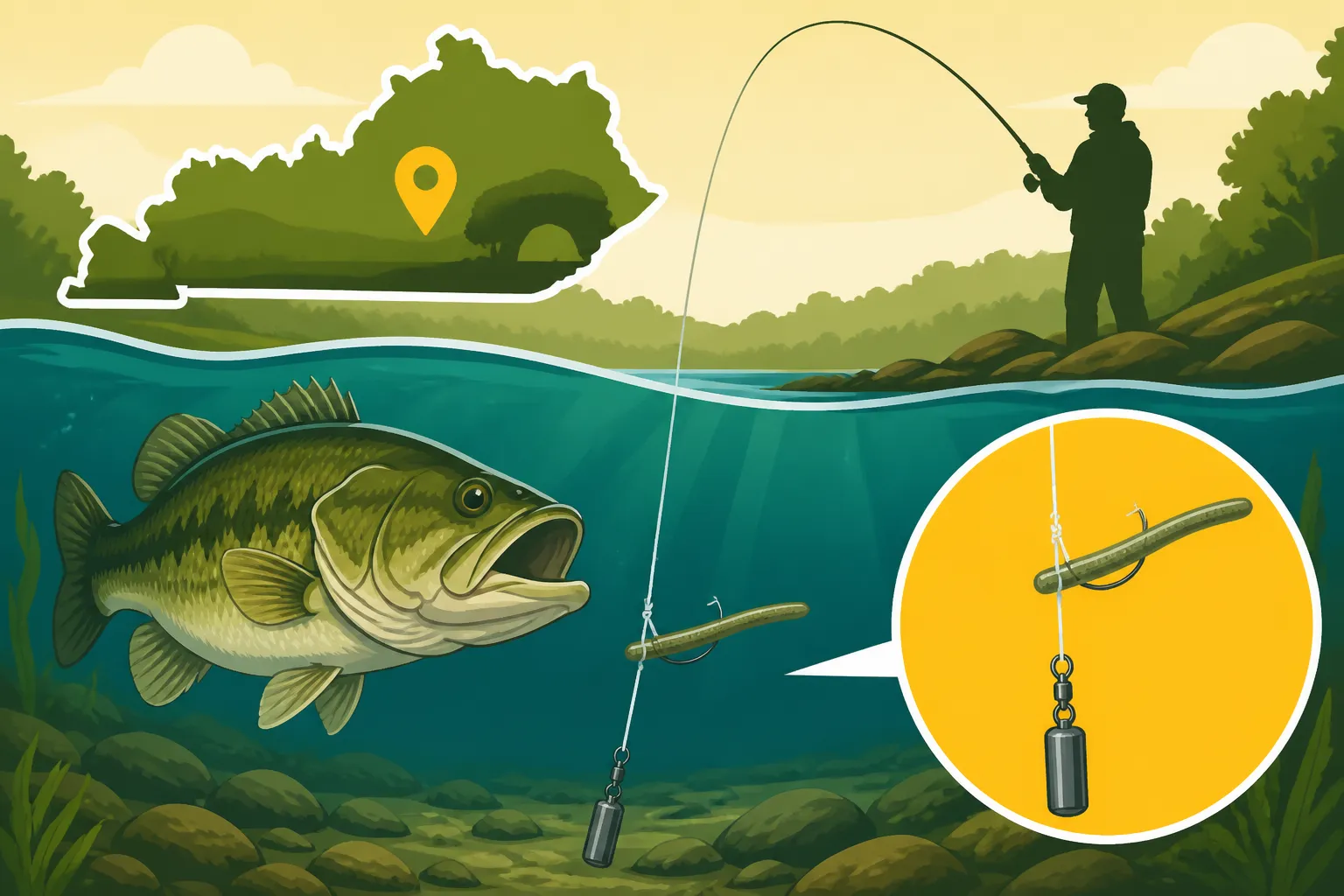
At its core, the drop shot is effective because it offers an incredibly natural and tantalizing presentation. Unlike a traditional Texas rig or jig, where your bait is always on the bottom, a drop shot suspends your soft plastic bait horizontally at a predetermined depth above a weight. This means your bait isn't dragging through muck or getting lost in thick cover unless you want it to. Instead, it hovers tantalizingly in the strike zone, mimicking a small baitfish or an insect just hanging out.
Imagine this scenario: you're fishing a deep ledge on Lake Cumberland, and your fish finder shows a school of bass suspended ten feet off the bottom in thirty feet of water. With a traditional jig, you'd have to constantly reel and drop, trying to keep your bait at that exact depth, which is nearly impossible. With a drop shot, you can set your weight on the bottom and your bait will simply hang there, right in the fish's face, with minimal effort. A slight twitch of the rod tip makes the bait dance and quiver, looking utterly irresistible. This vertical presentation also allows you to keep your bait in one spot for an extended period, working a specific piece of structure or a small school of fish thoroughly, which is often key when the bite is slow. It’s also incredibly sensitive; because the weight is separate from the hook, you can often feel the most subtle pick-ups, helping you detect those almost imperceptible bites from cautious bass.
Key Components of a Drop Shot Rig
Building an effective drop shot rig isn't overly complicated, but understanding each component is crucial to its success. It’s a finesse technique, meaning lighter gear is often preferred, but there are variations depending on the cover you’re fishing.
First, you'll need a rod that's sensitive enough to feel those light bites but has enough backbone to handle a good fish. Typically, a medium-light to medium power spinning rod, around 6'6" to 7'6" in length, with a fast or extra-fast action, is ideal. This combination allows for long casts, good bait control, and quick hook sets.
Next up is the reel. A 2000 or 2500 series spinning reel is usually perfect. It should have a smooth drag system, which is paramount when fighting a decent bass on light line. Don't skimp here; a jerky drag will cost you fish.
Your line choice is where things get a little nuanced. Many anglers opt for braided main line (6-10 lb test) for its sensitivity and casting distance, followed by a fluorocarbon leader (6-10 lb test). Fluorocarbon is nearly invisible underwater and has excellent abrasion resistance, which is important when fishing around rocks or brush piles. Alternatively, some prefer straight fluorocarbon for the entire setup.
The hook is perhaps the most critical component for proper bait presentation. You'll typically use a small, light-wire hook, either a straight shank or an "octopus" style hook, in sizes #1 to 1/0. The key is to nose-hook your soft plastic bait, meaning the hook point goes through just the very tip of the bait's nose. This allows the bait to move freely and naturally.
Then there's the weight. Drop shot weights are distinct, usually cylindrical or tear-drop shaped, designed to slip through cover easily and minimize snagging. They come with a special line-clip or swivel attachment that allows you to quickly adjust the distance between your bait and the weight without retying. Weights typically range from 1/8 oz to 1/2 oz, with 1/4 oz being a popular all-around choice. The general rule is to use the lightest weight possible that still allows you to maintain bottom contact and feel the bait effectively.
Finally, your bait choice is vast! Small soft plastic worms (like the Strike King Dream Shot or RoboWorm Straight Tail Worm), minnow imitations, or even small creature baits work wonders. The goal is to present something subtle and natural. Choosing the right bait and color for Kentucky's waters can make a huge difference.
Setting Up Your Drop Shot Rig Step-by-Step
Getting your drop shot rig tied correctly is half the battle. A properly rigged drop shot ensures your bait acts naturally and increases your hook-up ratio. It might seem intimidating at first, but with a little practice, you'll be tying them like a pro.
Choosing the Right Gear
As we discussed, the right gear makes a huge difference with finesse techniques. For Kentucky bass fishing, especially when you're targeting those pressured fish in clear water or tough conditions, a sensitive spinning rod is non-negotiable. Look for something labeled "drop shot" or "finesse" specific. Brands like St. Croix, G. Loomis, or even more budget-friendly options found on Amazon like the Abu Garcia Veritas series offer excellent sensitivity. For a reel, a Shimano Sedona or Daiwa Tatula LT are fantastic choices that provide smooth operation and reliable drag.
When it comes to line, I personally favor a braided main line with a fluorocarbon leader for most situations. The braid offers incredible sensitivity, helping you feel even the most subtle tick. I'll usually run 8 lb test Seaguar Smackdown braid, which has a super thin diameter and casts like a dream. To that, I'll attach a 6-8 lb test Seaguar InvizX fluorocarbon leader using a FG knot, which is a strong, low-profile knot that slides through guides easily. If you're new to the FG knot, don't worry, there are plenty of tutorials online, and it's worth the effort to learn. If you prefer to keep it simple, a straight fluorocarbon setup, like 8 lb test Berkley Vanish, works well too, but you might sacrifice a bit of sensitivity and casting distance. If you're just starting out, check out this guide on the Best Rod and Reel Combo for Beginners to help you get set up with basic versatile gear before specializing.
Tying the Knot and Attaching Components
Here’s the breakdown for rigging:
- Tie your hook: Start by threading your main line (or fluorocarbon leader if using braid) through the eye of your drop shot hook. I highly recommend using a Palomar knot for this. It's incredibly strong and reliable. The trick here is after you tie the Palomar knot and cinch it down, thread the tag end of your line back through the hook eye from the top down. This makes the hook stand out horizontally from the main line, which is absolutely crucial for the drop shot's natural presentation. You’ll be left with a tag end dangling downwards, which will eventually be tied to your weight.
- Determine your leader length: The length of your tag end below the hook dictates how far your bait will suspend off the bottom. If you're fishing grass or brush piles, you might want a longer leader (12-18 inches) to keep your bait above the snags. If bass are tight to the bottom or you’re fishing really clean rock, a shorter leader (6-8 inches) might be better. There’s no hard and fast rule; experiment to see what the fish prefer on any given day.
- Attach your weight: Now, take that tag end and attach your drop shot weight. Most drop shot weights have a swivel or a line-clip that allows you to simply thread the line through and cinch it down without tying a knot. This is awesome because it lets you quickly adjust your bait depth by sliding the weight up or down, or even pop it off if you get snagged without losing your hook and bait. If your weight requires a knot, a simple overhand knot cinched tightly will usually suffice, as the pressure will be on the main line above the hook.
Selecting Your Soft Plastics and Baits
The beauty of the drop shot is its versatility in bait choice. While thin, straight-tail worms are the classic and most popular option, don't be afraid to experiment.
- Straight-tail worms: These are your bread and butter. Think 4-6 inch worms with no paddle or curly tail. When nose-hooked, they quiver and undulate with the slightest movement, perfectly mimicking a struggling baitfish or a worm slowly dying. Popular choices include the RoboWorm Straight Tail Worm, Berkley Gulp! Minnow, or the Z-Man Trick ShotZ.
- Minnow imitations: Small fluke-style baits or even tiny swimbaits can be incredibly effective, especially when bass are keying in on baitfish. Nose-hooking these gives them a darting, evasive action.
- Creature baits: In certain situations, particularly around heavier cover or when bass are feeding on crawfish, a small creature bait or a finesse jig trailer can be surprisingly effective on a drop shot. Think about baits around 3-4 inches that have subtle appendages for movement.
- Color selection: This is key in Kentucky's varied waters. In clear reservoirs like Lake Cumberland, natural colors like greens, browns, and translucent shades with flake (e.g., "green pumpkin," "margarita mutilator," "natural shad") are often best. In stained or muddier waters, brighter colors or those with chartreuse or junebug hues can be more visible and provoke strikes. Always have a few options handy, because what works one day might not work the next!
Mastering the Drop Shot Presentation and Techniques
Once your rig is tied and ready, it's time to learn how to present it effectively. The drop shot is all about subtle movements and letting the bait do the work.
Finesse Presentations for Different Depths
The drop shot truly shines in its ability to be fished in various ways, always maintaining its natural presentation.
- Vertical Jigging: This is the most common and often most effective way to fish a drop shot, especially from a boat or kayak. Drop your rig straight down to the bottom, let the weight settle, and then reel up the slack until your line is taut. Your bait should be suspended perfectly. Then, use very slight twitches of your rod tip – think tiny movements, just enough to make the bait quiver. Keep your rod tip high and maintain slack in your line so the bait dances, but the weight stays still. This is deadly when you've located fish on your electronics, particularly when they're suspended on deep structure or ledges.
- Casting and Dragging: While often thought of as a vertical technique, the drop shot can be cast like any other bait. Make a long cast, let the weight sink to the bottom, and then slowly drag or hop the weight along. Every time you pause, your bait will suspend enticingly. This is excellent for covering wider flats, points, or when fishing from the bank. Just remember to maintain contact with the bottom with your weight, but let the bait itself do the dancing.
- Shaky Head Comparison: You might be wondering how this differs from a shaky head jig. While both are finesse techniques, the shaky head presents the bait on the bottom, usually with a weighted jig head that stands the worm up. The drop shot suspends the bait above the bottom. This difference is critical for finicky fish who might not want to root around in the bottom but will readily strike a bait hovering in their strike zone.
Reading the Water and Targeting Structure
Knowing where to throw your drop shot is just as important as how you fish it. Kentucky's diverse lakes and rivers offer countless opportunities for this technique.
- Deep Ledges and Humps: These are prime drop shot territory. Bass will often position themselves on the edges of ledges or on top of submerged humps, waiting to ambush bait. Use your electronics to find these structures and identify any suspended fish. If you're fishing deeper waters, especially in winter, a technique like this can really help with your Winter Fishing Techniques for Bass.
- Brush Piles and Timber: Bass love cover. Drop shotting around submerged brush piles, standing timber, or fallen trees can be incredibly effective. The advantage of the drop shot weight is its ability to slip through branches with fewer snags than a traditional jig. Just be sure to tie your hook with the point exposed for better hook sets, as weedless rigging isn't really a thing with nose-hooked drop shots.
- Rock Piles and Boulders: Rocky areas, particularly on lakes like Lake Barkley or Herrington Lake, are magnets for bass and crawfish. The drop shot allows your bait to dance above the jagged rocks without constantly getting snagged.
- Docks and Boat Houses: These structures provide shade, cover, and ambush points for bass. Pitching a drop shot under docks can draw strikes from fish hiding in the shadows. This is a great area to apply this technique, especially in lakes like Kentucky Lake: The State's Top Bass Fishing Destination, which has a lot of boat docks and marinas.
- Reading your electronics: A good fish finder is your best friend when drop shotting. Use it to pinpoint specific depths, identify schools of baitfish, and locate bass holding on structure. Learning How to Read a Fish Finder for Bass Fishing will drastically improve your success.
Detecting Bites and Setting the Hook
One of the trickiest parts of finesse fishing is detecting those subtle bites. Bass often won't hammer a drop shot; they'll just "tick" it or add a slight pressure.
- The "Tick" and the "Pressure": Pay close attention to your line. Any slight twitch, sudden slack, or feeling of added weight means a fish has picked it up. Sometimes it feels like nothing more than your line going suddenly limp, which means a fish has swam upwards with your bait.
- Line Watching: With braid, you can often see your line jump or move unnaturally before you even feel the bite. Keep your eyes peeled on the spot where your line enters the water.
- Gentle but Firm Hook Set: Because you're often using lighter line and a small hook, a violent, sweeping hook set isn't necessary, and can actually pull the hook out of the fish's mouth. Instead, when you feel a bite, just reel down to take up slack and give a firm, steady pull upwards or to the side. The sharp, exposed hook will do its job. Remember to keep constant pressure on the fish once it's hooked, letting your smooth drag do the work.
When and Where to Employ the Drop Shot in Kentucky
The drop shot is a year-round weapon, but there are certain times and places in Kentucky where it truly excels.
Seasonal Applications
This technique can put bass in the boat no matter the season, but it's particularly potent during specific periods.
- Post-Spawn: After the rigors of spawning, bass often retreat to deeper water or suspend off points. They can be finicky and less aggressive, making the subtle presentation of a drop shot incredibly effective. This is typically after the Kentucky Bass Fishing: The April-May Peak Season has peaked and fish are recovering.
- Summer Doldrums: When the heat sets in and bass go deep, the drop shot is one of the best ways to reach them. They'll often suspend over thermoclines or on deep structure, and the drop shot allows you to put a bait right in their face without overworking it. This is when fishing during the hot midday sun can be productive, whereas other techniques might struggle.
- Cold Fronts: Everyone dreads a cold front. The weather changes, the barometer drops, and the bass get lockjaw. This is precisely when you want a drop shot in your hand. Its subtle nature is perfect for enticing inactive or lethargic bass that won't chase a reaction bait. If you're fishing after a cold front, this is definitely a technique to try.
- Winter Fishing: When the water temperatures plummet, bass become slow and lethargic. They often congregate in deep holes, on steep breaks, or near main lake channels. The drop shot can be deadly for Winter Fishing Techniques for Bass because it allows you to present a bait vertically and keep it in the strike zone for extended periods, almost forcing a bite from slow-moving fish.
Specific Kentucky Lakes and Rivers
Kentucky boasts some fantastic bass fisheries where the drop shot can be a secret weapon.
- Kentucky Lake and Lake Barkley: These expansive impoundments on the Tennessee River system are famous for their ledge fishing. Bass often stack up on deep river ledges, humps, and shell beds. A drop shot is perfect for working these areas methodically, especially when fish are suspended or not actively chasing. Whether you're targeting largemouth or smallmouth, knowing your way around these lakes is key. For more in-depth knowledge, check out our Kentucky Lake: The State's Top Bass Fishing Destination guide.
- Lake Cumberland: Known for its clear, deep waters and excellent smallmouth fishery, Lake Cumberland is tailor-made for drop shotting. Smallmouth often suspend over deep rock piles, bluff walls, and points. The drop shot’s subtle presentation and fluorocarbon leader are invaluable in these clear conditions. Our Lake Cumberland: Kentucky's Best All-Around Fishing Lake article has even more insights.
- Herrington Lake: As one of Kentucky's deepest lakes, Herrington Lake offers plenty of deep-water opportunities for drop shot enthusiasts. Bass here often relate to steep bluffs, deep points, and submerged timber. The ability to fish vertically and adjust your bait's depth with the drop shot is crucial on this particular body of water. Learn more in our Herrington Lake Fishing Guide, Kentucky's Deep Water Bass Lake.
- Ohio River: While often associated with current and bigger baits, the Ohio River can also be excellent for drop shotting, particularly in slack water areas, around bridge pilings, or in rocky backwater channels where bass may be hiding tight to structure.
Essential Drop Shot Gear Checklist
To make sure you're fully equipped for your next Kentucky bass fishing adventure with a drop shot, here's a quick checklist of essential gear. You can find many of these items readily available on Amazon.
| Item Category | Specific Item | Key Features | Typical Use Case |
|---|---|---|---|
| Rods | Spinning Rod (M/ML Fast) | 6'6" – 7'6", Sensitive tip, good backbone | Versatile for casting and vertical presentations |
| Reels | Spinning Reel (2000/2500) | Smooth drag, lightweight, good line capacity | Managing light line, fighting finesse-caught bass |
| Line | Braided Line | 6-10 lb test, high sensitivity, thin diameter | Main line for casting distance and bite detection |
| Fluorocarbon Leader | 6-10 lb test, low visibility, abrasion resistant | Connecting to hook, providing stealth | |
| Hooks | Drop Shot Hook | #1 – 1/0, light wire, straight shank or octopus style | Nose-hooking soft plastics for natural action |
| Weights | Drop Shot Weights | 1/8 oz – 1/2 oz, cylindrical or tear-drop, quick-clip attachment | Maintaining bottom contact, adjusting bait depth |
| Baits | Straight Tail Worms | 4-6 inches, various colors (natural, bright) | Primary drop shot bait, mimics small prey |
| Minnow/Fluke Imits. | 2-4 inches, natural colors | When bass are keying on baitfish | |
| Small Creature Baits | 3-4 inches, subtle appendages | Around heavier cover or crawfish-feeding bass | |
| Accessories | Line Cutter | Sharp scissors or clippers for clean cuts | Trimming line and leader |
| Pliers/Hook Remover | For safely removing hooks and crimping weights | Safety and efficiency when unhooking fish |
Always remember that fishing without the proper documentation can lead to penalties. Make sure you have your Kentucky Fishing License Guide sorted before you head out!
Disclaimer
Always check the latest Kentucky Department of Fish and Wildlife Resources regulations before heading out on the water. Fishing conditions, regulations, and fish behavior can change rapidly. This guide is for informational purposes only and does not constitute professional advice.