Best Lures for Smallmouth Bass in Kentucky Rivers
Navigating the winding, often unpredictable currents of Kentucky's rivers in search of smallmouth bass can be one of the most rewarding — and sometimes frustrating — angling experiences. These feisty bronzebacks are a different breed from their lake-dwelling cousins, requiring specific tactics and, crucially, the right lures to entice a strike. This comprehensive guide will dive deep into the best lure choices and techniques to help you consistently hook up with smallmouth bass in the unique river environments across the Bluegrass State.
The Unique Challenge of River Smallmouth Bass
If you've spent any time chasing largemouth in a Kentucky lake, you know how different river fishing can be. River smallmouth bass are adapted to an entirely different world, one dictated by current, diverse bottom structures, and often, clearer water. Understanding these differences is the first step to choosing the right lure and presentation.
How River Smallmouth Differ from Lake Bass
River smallmouth are essentially lean, mean fighting machines, sculpted by constant current. Unlike lake bass that might hold tight to a submerged brush pile or a weed bed, river smallmouth are masters of using current to their advantage, conserving energy while ambush feeding. They tend to be more muscular, fight harder, and often strike with an intensity that can surprise even seasoned anglers. Their diet is also heavily influenced by what the river provides—crayfish, hellgrammites, minnows, and small baitfish are all fair game. This means your lure selection needs to mimic these prevalent food sources. What works wonders in a calm lake might get ignored or even washed out in a fast-moving river.
You'll find that these river fish are often more nomadic, moving between prime feeding lies as water levels and current speeds change. They aren't always in the same spot, meaning you need lures that allow you to cover water effectively and presentations that can cut through the current to reach them. If you're looking for a deeper dive into their habits, check out our Smallmouth Bass Fishing in Kentucky: The Complete Guide.
Key River Structures to Target
River smallmouth bass are incredibly structure-oriented, but "structure" in a river takes on a different meaning. Instead of vast humps or points, think smaller, more defined current breaks and ambush points.
- Rock Piles and Boulders: These are classic smallmouth havens. Rocks break the current, creating eddies and slack water where bass can rest and wait for food to be swept by. Larger boulders often have deeper scour holes on their downstream side, perfect ambush spots.
- Current Seams: Anywhere fast water meets slow water is a prime target. This could be behind a large rock, along the edge of a submerged log, or at the junction of a tributary. Smallmouth often sit in the slower water, darting into the faster current to snatch prey.
- Riffles and Runs: These shallower, faster-moving sections oxygenate the water and concentrate baitfish and insects. Smallmouth will often stage just downstream of these areas, or even hold in the faster water if there's enough cover.
- Ledges and Drop-offs: While not as common as in lakes, rivers with bedrock bottoms or old creek channels can have distinct ledges where smallmouth will patrol, especially in deeper pools.
- Woody Debris: Submerged logs, rootwads, and brush piles offer cover and current breaks. However, fishing these can be tricky due to snags, so choose your lures wisely.
Understanding how to read the water and identify these features will significantly increase your success. Sometimes, you'll be able to spot these structures from the bank, but other times you'll have to rely on feel or a good fish finder if you're in a boat or kayak. Learning to pick apart these river features is key, and understanding How to Read Water for Fish Location can give you a significant advantage.
Essential Hard Baits for River Current
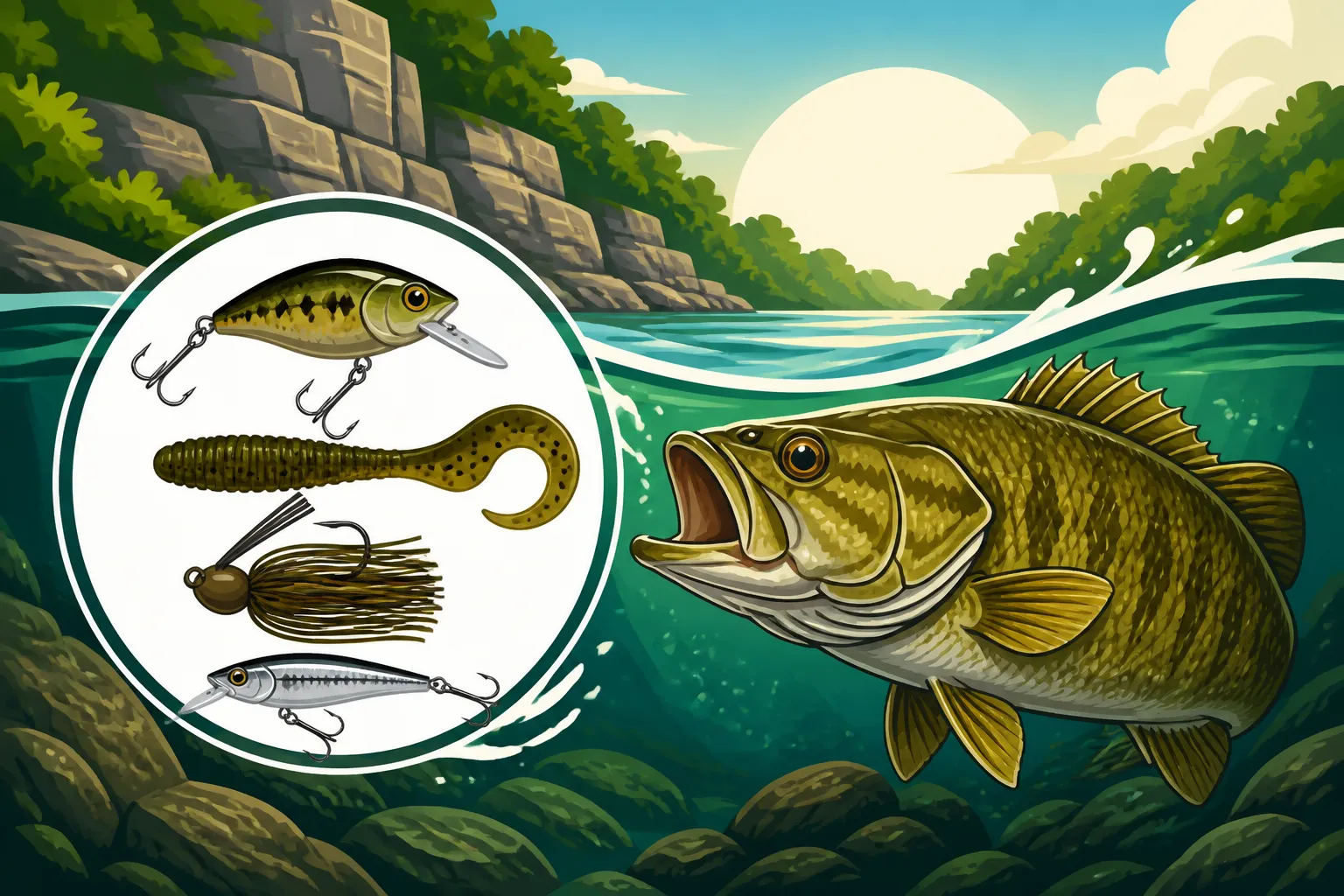
Hard baits are a cornerstone of river smallmouth fishing. Their ability to dive, wobble, and rattle in current makes them irresistible to aggressive bronzebacks. The trick is to select the right type and present it in a way that mimics natural prey being swept downstream.
Crankbaits: The Current Masters
Crankbaits are phenomenal for covering water and triggering strikes in river current. They come in various diving depths, allowing you to target fish from shallow riffles to deeper pools.
- Shallow-Diving Crankbaits (1-5 feet): These are perfect for working over rocky flats, through shallower runs, or around visible cover. Look for models with a tight wobble that won't get blown out by the current. Squarebill crankbaits are particularly effective in rocky rivers because their bill helps them deflect off obstructions rather than snagging. Cast them upstream or across current and retrieve just fast enough to get them digging and deflecting. Brands like Strike King and Rapala offer excellent river-specific crankbaits.
- Medium-Diving Crankbaits (5-12 feet): When smallmouth are holding a bit deeper, perhaps behind larger boulders or along submerged ledges, a medium-diver can be deadly. These can effectively probe the edges of deeper pools and scour holes. The key is to make contact with the bottom or structure; the deflections often trigger reaction strikes.
- Deep-Diving Crankbaits (12+ feet): While less common in many Kentucky rivers due to overall depth, these can be useful in very deep river bends or pools, especially when fish are relating to deep rock piles. However, be mindful of snagging in these deeper, often debris-filled sections.
When you're shopping for these, you'll find a massive selection on platforms like Amazon, making it easy to compare styles and colors.
Jerkbaits: Triggering Reaction Strikes
Jerkbaits are magic for their ability to suspend or slowly float in the water column, imitating a struggling baitfish. The stop-and-go retrieve of a jerkbait is often irresistible to smallmouth, especially in cooler water or when fish are a bit finicky.
- Suspending Jerkbaits: These are your go-to. Cast them out, twitch your rod tip a few times to get them diving and darting, then pause. The longer the pause, the better, especially in cold water. Smallmouth will often nail the lure on the pause as it hangs tantalizingly in the current.
- Floating Jerkbaits: Good for working over shallower cover where you want the bait to float up on the pause, avoiding snags.
- Retrieve Tips: A standard retrieve is a "twitch, twitch, pause" rhythm. Experiment with the length of your pauses and the aggressiveness of your twitches. In clear river water, natural baitfish colors (silver, perch, shad patterns) tend to work best. Jerkbaits are particularly effective in the spring and fall when smallmouth are still active but not chasing as aggressively as in summer.
Topwater Lures: Explosive Surface Action
There's nothing quite like a smallmouth blowing up on a topwater lure. River smallmouth are incredibly aggressive, and a properly worked topwater can draw them out from cover for an unforgettable strike.
- Poppers: These lures have a cupped face that "pops" or "chugs" water when twitched. They're excellent for targeting smallmouth holding tight to rocks, fallen trees, or current seams. Cast them close to cover, let the ripples dissipate, and then give a sharp twitch or two, followed by a pause.
- Walking Baits (Walk-the-dog style): Lures like Heddon Super Spooks or similar baits are designed to "walk" from side to side across the surface with a rhythmic retrieve. This darting action mimics a frantic baitfish and can call smallmouth from a surprising distance. They work best in calmer water sections or eddies, especially during low light conditions in the morning or evening.
- Buzzbaits: While often associated with largemouth, smaller buzzbaits can be fantastic for river smallmouth, especially around shallow, woody cover or along grass lines in slower sections. The gurgling, sputtering action of the blade draws attention and can provoke aggressive strikes from active fish. They are usually retrieved steadily, just fast enough to keep the blades churning on the surface.
Topwater action is generally best during warmer months, from late spring through early fall, and particularly during dawn and dusk. For specific lures that mimic local baitfish, you might want to consider what’s commonly found in your area.
Versatile Soft Plastics for Finesse and Imitation
Soft plastics offer unparalleled versatility for river smallmouth. They can be fished slowly, mimicking crayfish or injured baitfish, or quickly, imitating fleeing prey. Their soft texture and natural action are often the key to unlocking a bite when other lures fail.
Tubes: The River Smallmouth Staple
If there's one soft plastic you shouldn't leave home without for river smallmouth, it's the tube. These hollow, cylindrical baits with tentacled skirts are exceptional crayfish imitators, a primary food source for river smallmouth.
- Rigging: The most common way to rig a tube for river fishing is with an internal jig head. The weight of the jig head depends on the current and depth. In faster currents, you might need a heavier 1/8 to 1/4 ounce head to get it down. In slower water, a 1/16 ounce might suffice.
- Colors: Natural colors like green pumpkin, watermelon, brown, and black/blue are always reliable for imitating crayfish. If the water is stained, brighter colors like chartreuse or white can sometimes grab attention.
- Presentation: Tubes are incredibly effective when dragged or hopped along the bottom, mimicking a crayfish scuttling or fleeing. Cast upstream or across current, let it sink, and maintain just enough tension to feel the bottom and any strikes. They are also great for pitching into eddies or behind rocks, allowing them to drift naturally into strike zones.
The versatility of tubes makes them a must-have in your tackle box, whether you're working the deep pockets or shallow rocky areas.
Grubs and Swimbaits: Mimicking Forage
These soft plastics excel at imitating baitfish and smaller aquatic creatures, and they are incredibly effective for smallmouth.
- Single-Tail Grubs: Simple, yet deadly. Rigged on a plain jig head (1/8 to 1/4 ounce), a single curly-tail grub can be fished with a steady retrieve, a lift-and-drop, or bounced along the bottom. The vibrating tail provides plenty of action. White, chartreuse, smoke, and natural baitfish colors are excellent choices. They're particularly good when smallmouth are feeding on shad or minnows.
- Paddle-Tail Swimbaits: These baits, often with a realistic baitfish profile and a thumping paddle tail, are fantastic for drawing aggressive strikes. They can be rigged on an exposed jig head or on a weedless swimbait hook. Work them with a steady retrieve, a stop-and-go, or even slow-rolled along the bottom. Sizes from 2.5 to 4 inches are typically ideal for river smallmouth. Amazon has a wide variety of these, making it easy to find different brands and styles.
- Fork-Tail Swimbaits: These have a more subtle, darting action. Rigged on an underspin jig head, they can offer a unique presentation that smallmouth often haven't seen.
These lures are great for covering water and targeting active fish.
Finesse Rigs: Ned Rigs and Wacky Worms
When the bite gets tough, or smallmouth are heavily pressured, finesse techniques with soft plastics can often save the day.
- Ned Rig: This minimalist presentation is devastatingly effective for smallmouth. It consists of a small, mushroom-shaped jig head (typically 1/10 to 1/6 ounce) paired with a small, buoyant soft plastic stick bait (like a Z-Man Finesse TRD). The buoyancy of the plastic causes it to stand up off the bottom, creating an irresistible, subtle presentation. Cast it out, let it sink, and then simply drag or hop it slowly along the bottom. The key is extreme patience.
- Wacky Rig: A simple straight worm (often a Senko-style bait) hooked through the middle, allowing both ends to wiggle freely as it falls. This rig has an incredibly natural, enticing fall that smallmouth find hard to resist. While more commonly used in lakes, a weightless wacky worm can be very effective in slower eddies or calmer pools where the current isn't too strong. Use a light wire hook and let the bait do the work.
These finesse presentations often require lighter tackle, which you can read more about in our guide to Best Rods and Reels for Kentucky Fishing.
Other Productive Lures and Tactics
Beyond the main categories, a few other lure types and techniques consistently produce river smallmouth in Kentucky. Don't overlook these options, as they can sometimes be the silver bullet you need for a successful day.
Spinnerbaits and Buzzbaits: Covering Water
While we touched on buzzbaits for topwater, it's worth expanding on the utility of both spinnerbaits and buzzbaits for efficient smallmouth fishing in rivers.
- Spinnerbaits: These versatile lures excel at covering water quickly and working through cover. The flash of the blades and the vibration of the skirt are powerful attractants. In rivers, spinnerbaits with tandem willow leaf blades (for a more subtle flash and good current penetration) or Colorado blades (for maximum thumping vibration in stained water) are excellent. Weight them according to the current – usually 3/8 to 1/2 ounce. Cast them into current breaks, along rocky banks, or around submerged timber and retrieve steadily. The key is to keep them just above the snags.
- Buzzbaits: As mentioned, smaller buzzbaits (1/4 to 3/8 ounce) can be fantastic. Their weedless nature allows them to be fished over shallow rocks, downed trees, and even through sparse emergent vegetation that might snag other topwater lures. The commotion on the surface often triggers explosive strikes from aggressive smallmouth. Look for opportunities to run them along current seams or over shallow rocky shelves.
Both of these lures are excellent choices for locating active fish quickly, especially during periods of higher fish activity.
Jigs and Trailers: Bottom Bouncing Delights
Jigs are perhaps the most versatile lure in a smallmouth angler's arsenal, allowing for countless presentations that mimic everything from crayfish to baitfish.
- Football Jigs: Named for their head shape, football jigs excel at crawling over rocky bottoms without snagging. They're perfect for presenting a bulkier profile that imitates a large crayfish. Pair them with a soft plastic crayfish imitation trailer in natural colors like green pumpkin, brown, or black/blue. Work them slowly, dragging and hopping them along deep ledges, current breaks, and gravel beds.
- Arkie Jigs: With a more pointed head, Arkie jigs are good for fishing around wood and in slightly softer bottoms. They still do well on rocks but can be a bit more prone to snagging than football jigs.
- Hair Jigs: Often overlooked, hair jigs (like marabou or deer hair jigs) have a natural, undulating action in the water that's incredibly appealing to smallmouth, especially in clear, cold water. They are usually fished without a trailer for a more subtle presentation. Retrieve them with a slow, erratic twitch, mimicking a struggling baitfish or insect.
- Trailers: The right trailer can significantly enhance your jig's appeal. Crayfish imitations are standard, but paddle-tail grubs, chunk baits, or even small creature baits can add bulk, action, and scent.
Jigs are a go-to lure when smallmouth are holding tight to the bottom or when fishing deeper pools.
Matching Lures to Kentucky River Conditions and Seasons
Understanding the seasonal patterns and how river conditions fluctuate is paramount to consistent smallmouth success. The "best" lure can change dramatically from one month to the next, or even from morning to afternoon, based on factors like water temperature, flow, and clarity. To truly optimize your lure selection, consider the time of year and the current state of the river.
Spring: Pre-Spawn and Early Season Tactics
Spring in Kentucky's rivers is a time of transition, with smallmouth bass moving from their deep wintering holes to shallower spawning areas. This period typically sees fluctuating water temperatures and can often bring higher, murkier water from spring rains.
- Pre-Spawn (March-April): As water temperatures creep into the 40s and 50s, smallmouth begin to become more active, feeding heavily to prepare for the spawn. They'll often stage in deeper pools adjacent to shallower spawning flats or gravel bars.
- Lure Choices: Jerkbaits are phenomenal during this cooler pre-spawn period. Their suspending action allows you to keep the lure in the strike zone longer. Slowly retrieved crankbaits (medium divers) that bump off the bottom can also be effective. Jigs with crayfish trailers fished slowly are another excellent option, as crayfish are a key food source. Look for those staging areas where current isn't too strong.
- Spawn (Late April-May): When water temperatures hit the mid-50s to low 60s, smallmouth will move onto shallower gravel and rock beds to spawn. While you should avoid actively targeting bedding fish, those guarding nests will strike defensively.
- Lure Choices: Smaller soft plastics like Ned Rigs or tubes fished subtly can provoke strikes from guarding fish. Small swimbaits or grubs can also be effective if you're targeting fish moving in and out of spawning areas. This is also when you might start seeing some topwater action on warmer, overcast days in calmer water. For a broader look at what's biting, check out Kentucky Fishing Seasons: What to Catch Each Month.
Summer: Aggressive Feeding and Low Water
Summer is prime time for river smallmouth, with warmer water increasing their metabolism and making them incredibly active. Lower water levels often concentrate fish and make them easier to locate, but can also make them warier in clear conditions.
- Post-Spawn to Mid-Summer (June-August): Smallmouth are actively feeding and often spread throughout the river, relating to a variety of structures. The warmer water means they'll chase fast-moving baits.
- Lure Choices: Topwater lures (poppers, walking baits, buzzbaits) are fantastic, especially during low light hours or on overcast days. Crankbaits (squarebills in shallow riffles, medium divers in deeper runs) can be burned through current for reaction strikes. Spinnerbaits and small swimbaits are also excellent for covering water quickly and locating active fish. Jigs with trailers remain effective, particularly when fish are holding in deeper shade or current breaks. For those hotter summer days, look for deeper scour holes and shaded areas created by overhanging trees or large boulders. You can often find great deals on summer fishing gear through Amazon during this peak season.
Fall: Feeding Frenzy Before Winter
As water temperatures begin to drop in the fall, smallmouth enter a "feeding frenzy" phase, aggressively gorging themselves to build up fat reserves for winter. This can be one of the most exciting times to fish.
- Early to Mid-Fall (September-October): Fish are actively moving and feeding. Water levels tend to stabilize, and currents can be more predictable.
- Lure Choices: Crankbaits, especially those that dive to medium depths and can deflect off rock, are highly effective. Jerkbaits become increasingly productive as water cools, allowing for longer pauses. Spinnerbaits are still great for covering water. Jigs with crayfish trailers are deadly, particularly when worked along deeper current breaks and rocky banks where smallmouth are hunting crayfish. Topwater action can still be good, especially during Indian Summer days, but typically transitions to subsurface baits as the water gets colder. If you're looking for Best Lures for Early Spring Fishing, many of these fall lures will also transition well into that season.
Water Clarity and Flow: Making the Call
River conditions are never static, and adapting your lure choice based on water clarity and flow is crucial.
- Clear Water: In clear water, smallmouth rely heavily on sight. Opt for more natural colors (greens, browns, clear with flecks) and realistic lure profiles. Finesse presentations like Ned Rigs and wacky worms shine here. Lighter line and a stealthy approach are also beneficial.
- Stained/Murky Water: When the water is stained, smallmouth rely more on vibration and contrast. Use brighter colors (chartreuse, white, orange) and lures that create a lot of commotion, like spinnerbaits with large Colorado blades, noisy crankbaits, or buzzbaits. Darker colors like black/blue can also provide a strong silhouette.
- High Flow/Fast Current: In high flow, smallmouth will seek refuge in slack water or behind large current breaks. You'll need heavier lures (heavier jig heads, deep-diving crankbaits) to get down to them and maintain contact with the bottom. Lures with a tight wobble that won't blow out are preferred.
- Low Flow/Slow Current: In low flow, smallmouth might spread out more, but also become warier. Lighter lures, more subtle presentations, and finesse tactics often work best. Topwater can be exceptional in these conditions.
Knowing how to adjust your lure choices and techniques after a significant rain or How to Adjust Your Technique After a Storm will make you a much more successful river angler. Always remember to check local fishing regulations, as species-specific limits and rules can vary from one body of water to another.
Smallmouth Bass Lure Quick Reference Table
To help you quickly decide what to tie on, here’s a summary of the best lures for smallmouth bass in Kentucky rivers, along with their ideal conditions and general retrieve tips.
| Lure Type | Best Conditions | Retrieve Tips | Key Benefits |
|---|---|---|---|
| Jerkbaits | Cold/Cool Water, Clear to Lightly Stained, Pre-Spawn | Twitch-twitch-pause, varying pause length; allow to suspend | Triggers reaction strikes, excels in cooler water, hangs in strike zone |
| Crankbaits | All Water Temps, Varied Clarity, Covering Water | Steady retrieve, deflect off structure, vary speed | Covers water fast, great for rocky bottoms, good reaction bite |
| Topwater Lures | Warm Water (Summer, Fall), Low Light, Calm Sections | Pop/Chug (poppers), Walk-the-dog (walking baits), Steady (buzzbaits) | Exciting strikes, good for shallow cover, effective in low light |
| Tubes | All Water Temps, Varied Clarity, Rocky/Gravel Bottom | Drag, hop, twitch along bottom; mimic crayfish | Highly versatile, excellent crayfish imitation, subtle presentation |
| Grubs/Swimbaits | All Water Temps, Varied Clarity, Mimicking Baitfish | Steady retrieve, lift-drop, slow roll; vary jig head weight | Realistic baitfish imitation, good for covering water, consistent action |
| Ned Rigs | Tough Bite, Clear Water, Cold Fronts | Drag slowly, light hops along bottom; minimal movement | Finesse presentation, subtle action, stands up on bottom, effective on wary fish |
| Spinnerbaits | All Water Temps, Stained Water, Covering Water | Steady retrieve, slow roll, bump off cover | Great for stained water, vibration and flash attract, good for wood/rock |
Disclaimer
This article is for general informational purposes only and does not constitute professional advice. Laws, prices and regulations vary by location and change over time. Consult a qualified professional for guidance on your specific situation.