Best Marine Electronics for Ohio River Fishing
The Ohio River is a powerhouse for fishing, but let's be honest, it's also a challenging beast with its strong currents, commercial traffic, and constantly shifting bottom. Trying to fish it effectively without the right tools can feel like looking for a needle in a haystack blindfolded. This guide is all about cutting through that frustration, showing you how to equip your boat with the best marine electronics to safely navigate, locate fish, and conquer the mighty Ohio.
Navigating the Challenges of Ohio River Fishing with Electronics
Fishing the Ohio River isn't like drifting on a calm lake; it's a dynamic environment that demands more from your gear. The constant current, the unpredictable changes in depth, the hidden hazards, and the sheer volume of water make it essential to have reliable electronics that can keep up. Without them, you're not just missing out on fish; you could be compromising your safety and efficiency.
Why the Ohio River Demands Specific Electronic Tools
The Ohio River is a beast of its own, with unique characteristics that make standard fishing electronics often fall short. We're talking about a river that sees barges measuring hundreds of feet, strong currents that can move your boat faster than you'd like, and a bottom that’s constantly being scoured and reshaped. You need systems that can cope with turbidity, pinpoint subtle changes in structure, and provide rapid updates to keep you on course and on fish. This isn't just about finding a brush pile; it's about avoiding submerged logs, identifying subtle current breaks, and marking those fleeting sauger runs that only last for a few hours.
It's a place where knowing the depth isn't enough; you need to understand the contours, the drop-offs, and where the current is digging out those prime catfish holes. The Ohio River really tests your electronics, demanding clarity and accuracy even in less-than-ideal conditions. If your equipment isn't up to snuff, you'll spend more time guessing and less time actually fishing, and that's just plain frustrating when you know big fish are swimming beneath you.
Essential Navigation: GPS and Chartplotters
When you're out on the Ohio, a reliable GPS and chartplotter isn't a luxury; it's an absolute necessity. Imagine trying to navigate a bustling highway blindfolded – that's what it feels like without these tools on the river. These devices do so much more than just tell you where you are; they allow you to safely navigate around commercial traffic, avoid dangerous wing dams, and keep you in the navigable channel. More importantly for anglers, they let you precisely mark those honey holes – that particular rock pile, the subtle bend in a creek channel, or that isolated piece of timber where you just hooked a monster blue cat.
Modern chartplotters come loaded with highly detailed mapping, often featuring contour lines that show depth changes even on the river bottom. These maps can be a game-changer for understanding structure that you can't see from the surface. Brands like Humminbird and Garmin offer excellent mapping solutions, sometimes even preloaded with river charts. Being able to drop a waypoint exactly where you got a bite, or where you spotted a promising piece of cover with your sonar, means you can return to that spot with uncanny accuracy, even days or weeks later. This precision is especially critical on a river like the Ohio where currents and passing barges can make visual landmarks unreliable. Having a digital breadcrumb trail back to your best spots can save you hours of searching.
Seeing Beneath the Surface: Sonar and Fish Finders
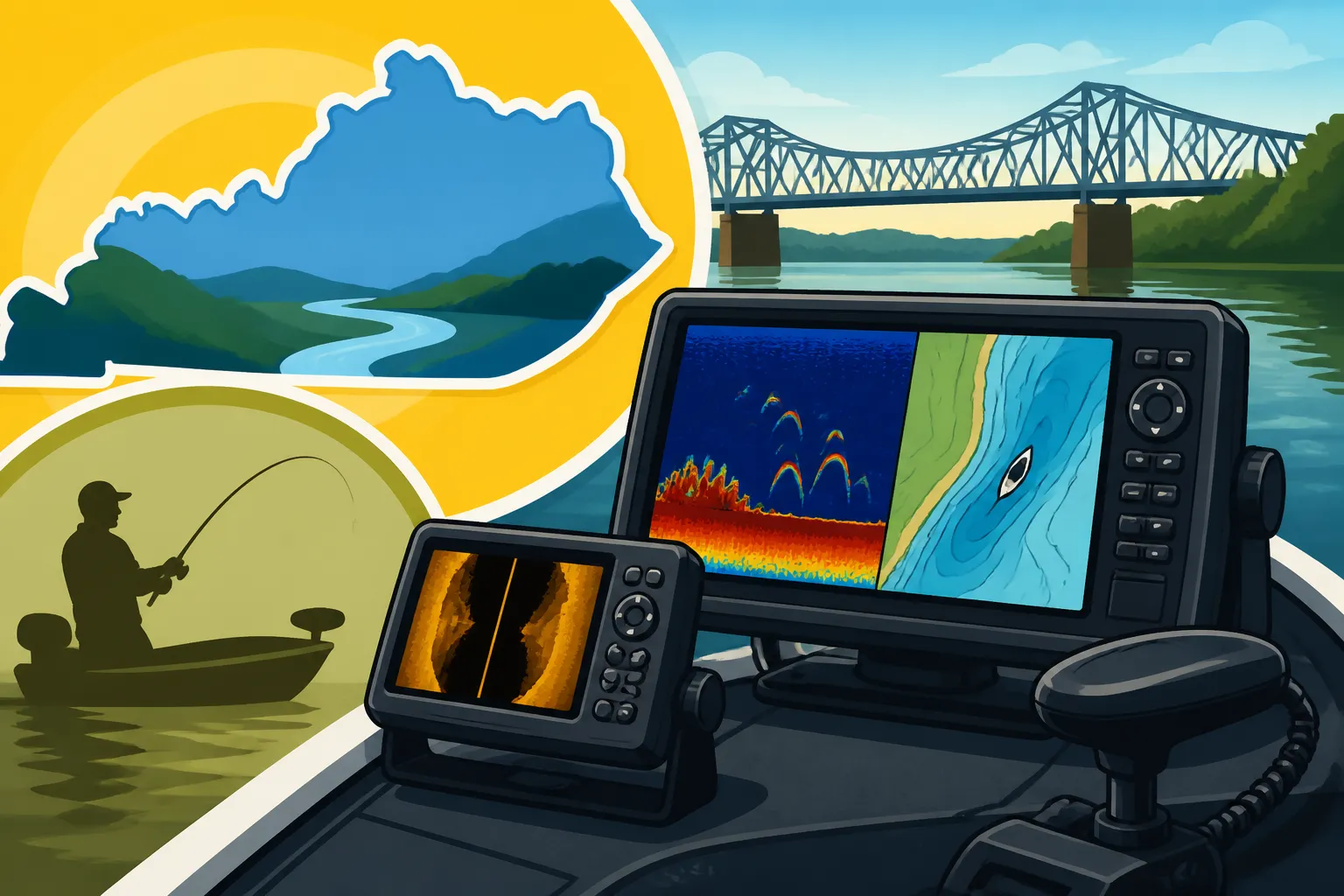
If GPS tells you where you are, then sonar and fish finders tell you what's under you, and that's where the real magic happens for fishing the Ohio. Traditional 2D sonar gives you a basic view, showing fish arches and bottom composition, but on the Ohio, you'll really want to step up your game. Down imaging offers a photo-like view directly beneath your boat, making it easier to distinguish between a submerged tree and a school of baitfish. Side imaging, however, is often the true hero for river anglers.
With side imaging, you can scan huge swaths of water to either side of your boat, uncovering hidden structure, drop-offs, and fish that would be impossible to find with traditional sonar alone. Think about those long, flat stretches of the Ohio River; side imaging allows you to quickly sweep for submerged stumps, rock piles, or channel edges without having to drive directly over them. This is especially vital when you're targeting fish like catfish or sauger, which often relate tightly to subtle changes in the bottom or structure that's hard to locate. Investing in a quality fish finder with these capabilities, often available from stores like Bass Pro Shops or online through Amazon, can drastically improve your catch rates by showing you exactly where the fish are hiding, even in the sometimes murky waters of the Ohio. You'll want to check out Kentucky Catfish Daily Limit and Trophy Fish Rule and Where to Catch Sauger on the Ohio River in Kentucky for more on targeting those specific species.
Deep Dive into Sonar Technologies for River Success
The Ohio River presents a unique set of challenges for sonar technology, from fluctuating water levels and turbidity to the sheer power of its current. To truly dominate your fishing experience here, you need to understand the nuances of various sonar systems and how they perform in this specific environment. It's not just about having a fish finder; it's about having the right kind of fish finder and knowing how to interpret its display.
Unlocking Structure with Side and Down Imaging
Side imaging and down imaging are truly transformative technologies for river fishing, especially on a complex system like the Ohio. While traditional 2D sonar paints a picture of what's directly beneath your boat in a conical beam, down imaging refines this with a much narrower, more detailed beam, essentially giving you a "picture" of the bottom directly below. You can clearly see individual branches of a submerged tree, distinct rock piles, or even the subtle elevation changes that indicate a scour hole where a monster blue cat might be lurking.
Side imaging takes this a step further, sending out beams to the left and right of your boat, painting a high-resolution image of the river bottom and anything on it for hundreds of feet in each direction. This is invaluable on the Ohio, where current-swept ledges, old foundations, and barge-carved depressions can hold significant numbers of fish but are scattered across vast areas. With side imaging, you can run parallel to a bank or a channel edge and quickly identify cover, baitfish schools, and even individual game fish hiding within that structure. It allows you to prospect large areas quickly, rather than slowly idling over every potential spot. Imagine scanning an entire stretch of river for submerged debris or a rock vein that attracts Best Hybrid Striped Bass Spots on the Ohio River in Kentucky, all without ever driving directly over them and potentially spooking the fish.
Choosing the Right Transducer for River Conditions
Your transducer is the unsung hero of your sonar system; it's the component that sends and receives the sound waves that create your underwater picture. For Ohio River fishing, selecting the right transducer, and ensuring it's properly mounted, is absolutely critical. A quality transducer will cut through the noise of the current and provide clear, consistent readings. You'll want to consider transducers that support multiple frequencies. Higher frequencies (like 800 kHz or 1.2 MHz for side/down imaging) offer incredible detail and target separation, which is fantastic for distinguishing a fish from a piece of cover in relatively shallow, clear conditions. However, they don't penetrate as deep or spread as wide.
Lower frequencies (like 200 kHz or 455 kHz) are better for deeper water penetration and a wider cone angle, which can be useful when you're trying to find fish in deeper holes or if the river water is particularly turbid after a rain. Many modern fish finders come with "CHIRP" technology, which sweeps a range of frequencies to provide even better target separation and clarity at varying depths. For the Ohio, a transducer that can handle both detailed high-frequency imaging and robust deeper penetration is ideal. Proper placement, typically on the transom or embedded in a trolling motor, is also key to preventing turbulence from affecting your signal – especially important when you're running upstream against a strong current. This directly impacts how effectively you can use your Best Boats for Ohio River Catfishing in Kentucky.
The Advantage of Real-Time, Live Sonar
For the cutting-edge angler on the Ohio River, live sonar technology is changing the game. Systems like Garmin LiveScope, Humminbird Mega Live, or Lowrance ActiveTarget allow you to see fish, bait, and your lure in real time, moving dynamically on your screen. This isn't just a historical record of what you've passed over; it's like watching an underwater video feed. Imagine casting a jig to a submerged rock pile, and seeing your jig fall, then watching a fish swim out from the rocks and track it, even seeing it react to your retrieve.
This technology is particularly potent for targeting individual fish or small schools around specific structures, which is a common scenario for species like walleye, sauger, and even larger catfish relating to cover. It removes much of the guesswork from subtle presentations. When vertical jigging for sauger in a deep current seam, being able to see exactly where the fish are in the water column and how they're responding to your lure is an unparalleled advantage. It allows for instant adjustments to depth, retrieve speed, and even lure choice, truly maximizing your time on the water and leading to more bites. While an investment, the immediate feedback it provides can be invaluable for refining your techniques and finding those finicky fish that might ignore traditional presentations.
Powering and Optimizing Your Ohio River Electronic Setup
Having the best marine electronics on the Ohio River won't do you much good if they're not powered correctly or optimized for peak performance. The river's demanding environment means you can't cut corners on your power systems or installation. Reliability is paramount, especially when you're miles from the ramp and relying on your gear for navigation and fish location.
Robust Battery Systems and Wiring for Marine Electronics
Running multiple high-tech marine electronics – a large screen chartplotter, side imaging sonar, a powerful trolling motor, and maybe even live sonar – draws a significant amount of power. Skimping on your battery system on the Ohio River is a recipe for frustration and prematurely dead electronics. You'll want to invest in dedicated deep-cycle marine batteries, and often, multiple batteries are necessary. Many anglers run a dedicated starting battery for their outboard and separate battery banks for their trolling motor and all other accessories.
Proper wiring is just as crucial. Use marine-grade, appropriately gauged wire that can handle the amperage draw of your units without voltage drop. Poor wiring can lead to erratic performance, freezing screens, and even damage to your sensitive electronics over time. All connections should be waterproofed and secured to withstand the vibrations and moisture inherent in a boat environment. Think about your charging system too; a quality onboard charger will keep your batteries topped off and extend their lifespan, ensuring you have consistent power for a full day of Best Catfish Fishing Spots on Kentucky's Ohio River or any other angling pursuit. You want to avoid the headache of a dead battery when you're in the middle of a hot bite.
Perfecting Your Transducer Placement for Optimal Readings
The clearest sonar picture is only as good as its transducer's ability to "see" underwater, and on the Ohio River, proper transducer placement is absolutely critical. Turbulence from your boat's hull or propeller can wreak havoc on your sonar signal, creating noise and clutter on your screen that obscures fish and structure. For stern-mounted transducers, often the best location is on the transom, slightly to one side of the engine, in an area that remains clear of aerated water when the boat is on plane. Some anglers opt for a shoot-through-hull transducer, which offers protection but can sometimes lose a bit of sensitivity.
Many experienced river anglers also choose to mount a dedicated transducer on their trolling motor. This gives you an unobstructed view when you're fishing slowly or on Spot-Lock, as the trolling motor is typically deeper and in cleaner water than the transom. This setup is particularly effective for down and side imaging, as well as live sonar, providing crystal-clear images of what's directly in front or to the sides of your bow. Experimentation might be needed to find the sweet spot, but investing time in correct installation will pay dividends in clearer, more reliable readings, which means you'll see more fish and structure on the Kentucky Fishing Regulations Explained.
Staying Current with Software and Mapping Updates
Your marine electronics are essentially specialized computers, and like any computer, they benefit greatly from regular software updates. Manufacturers frequently release updates that improve performance, add new features, fix bugs, and enhance the compatibility of your units. It's usually a simple process, often involving downloading files to a memory card from the manufacturer's website (easily found with a quick search on Amazon or directly through brands like Humminbird or Garmin) and then inserting it into your unit. Staying up-to-date ensures you're getting the most out of your investment.
Equally important for Ohio River fishing are mapping updates and detailed charting. Standard base maps on many units are good for basic navigation, but dedicated mapping cards (like Navionics or C-MAP) offer hyper-detailed contours, navigation aids, and even community-sourced information that can reveal subtle underwater features crucial for finding fish. These maps are constantly being refined, so keeping them updated is vital. Think of it like this: your GPS tells you where you are, but a detailed, updated map tells you why you want to be there. For instance, knowing the exact location of a submerged pipeline or an old ferry crossing can be the key to unlocking a fantastic fishing day. For more on river navigation and safety, consult Kentucky Boat Safety Certificate Requirements.
Integrating Your Marine Electronics for a Seamless Fishing Experience
The days of standalone fish finders are largely behind us, especially for serious anglers tackling challenging waters like the Ohio River. Modern marine electronics are designed to work together, creating a powerful, interconnected system that maximizes your efficiency and effectiveness on the water. Integrating your devices means they can share data, communicate seamlessly, and ultimately give you a comprehensive understanding of your environment.
Building a Connected Network on Your Boat
Imagine your fish finder seeing a school of baitfish near a submerged log, and that information automatically being shared with your bow-mounted chartplotter, showing you the exact location on your detailed map. This is the power of a networked system. Most major marine electronics brands offer networking capabilities, often through Ethernet cables, allowing multiple units to share sonar data, GPS coordinates, and mapping information. This means you can have a large screen at your console for navigation and wide-area scanning with side imaging, and a smaller, dedicated unit at the bow for up-close fishing with traditional sonar and live views.
This integration streamlines your fishing process. You're not flipping between screens or trying to remember numbers; the information is where you need it, when you need it. Some systems even allow for wireless connectivity to tablets or smartphones, giving you a secondary display or the ability to control certain functions remotely. When you're dealing with the currents and complexities of the Ohio River, a unified system reduces mental clutter and allows you to focus on the fishing, not fiddling with individual devices. For larger boats, networking is almost a must, connecting everything from your main fish finder to your radar and even your engine diagnostics.
The Smart Trolling Motor: Integration for Precision Control
Trolling motors have come a long way from simple thrust machines; they are now sophisticated tools that integrate deeply with your marine electronics. The most popular feature, often called "Spot-Lock" (Minn Kota) or "Anchor" (Motorguide), uses GPS to hold your boat precisely in one spot, regardless of wind or current. On the Ohio River, where current is a constant factor, this is an absolute game-changer. No more constantly adjusting your position; you can stay locked on a specific piece of structure, a current seam, or a hot fishing spot like the ones outlined in Best Paddlefish Snagging Spots on the Ohio River, Kentucky.
Further integration allows your trolling motor to "follow" a contour line on your chartplotter's map, maintain a specific heading, or even retrace a previous path. You can mark a waypoint on your fish finder screen where you caught a fish, and then instruct your trolling motor to navigate back to it automatically. This kind of hands-free control frees you up to focus entirely on fishing, making casts, and managing your lines, rather than constantly steering the boat. This level of precision fishing is invaluable for targeting specific species or working small, productive areas on the challenging Ohio River.
Portable Solutions for Bank Anglers and Small Craft
While much of the discussion about marine electronics focuses on larger, boat-mounted systems, there are fantastic portable options available for those who fish from the bank, kayaks, canoes, or smaller jon boats on the Ohio River. You don't need a full-blown bass boat to benefit from technology! Handheld GPS units, available from retailers like Bass Pro Shops or on Amazon, can still provide crucial navigation, allow you to mark waypoints, and help you find your way back to your vehicle or a favorite bank fishing spot. They might not have detailed river charts, but they're excellent for personal navigation.
For those in kayaks or smaller boats, portable fish finders are a fantastic option. Many models attach to your boat with suction cups or clamps, and often have compact, self-contained battery packs. These units can give you basic depth readings, show fish arches, and some even offer basic down imaging. While they won't have the expansive side imaging of larger units, they provide a significant advantage over fishing blind. For a kayak angler drifting a current seam, knowing the depth and seeing a school of baitfish can make all the difference. Even bank anglers can benefit from castable sonar devices that pair with a smartphone, allowing them to scan limited areas directly in front of them to locate structure or depth changes. Every bit of information helps, no matter the size of your craft.
| Marine Electronic Type | Primary Function on Ohio River | Key Advantage for Anglers |
|---|---|---|
| GPS/Chartplotter | Navigation, hazardous area avoidance, waypoint marking | Safe travel, precise return to hot spots, detailed river maps |
| 2D Sonar | Basic depth, fish arches, bottom composition | Fundamental fish/structure detection beneath the boat |
| Down Imaging | Photo-like detail directly below the boat | Clear identification of submerged structure like trees, rocks |
| Side Imaging | Scans wide areas to left/right of boat | Rapidly locates scattered structure, cover, and fish over large areas |
| Live Sonar | Real-time view of fish, bait, and lure | See how fish react to lure, target individual fish, refine presentation |
| VHF Radio | Communication, weather alerts, emergency calls | Crucial safety on busy commercial waterway, communication with other boaters |
| Trolling Motor (GPS) | Spot-Lock, auto-pilot, contour following | Hands-free boat positioning, precise bait presentation in current |
Disclaimer
This article is for general informational purposes only and does not constitute professional advice. Laws, prices and regulations vary by location and change over time. Consult a qualified professional for guidance on your specific situation.