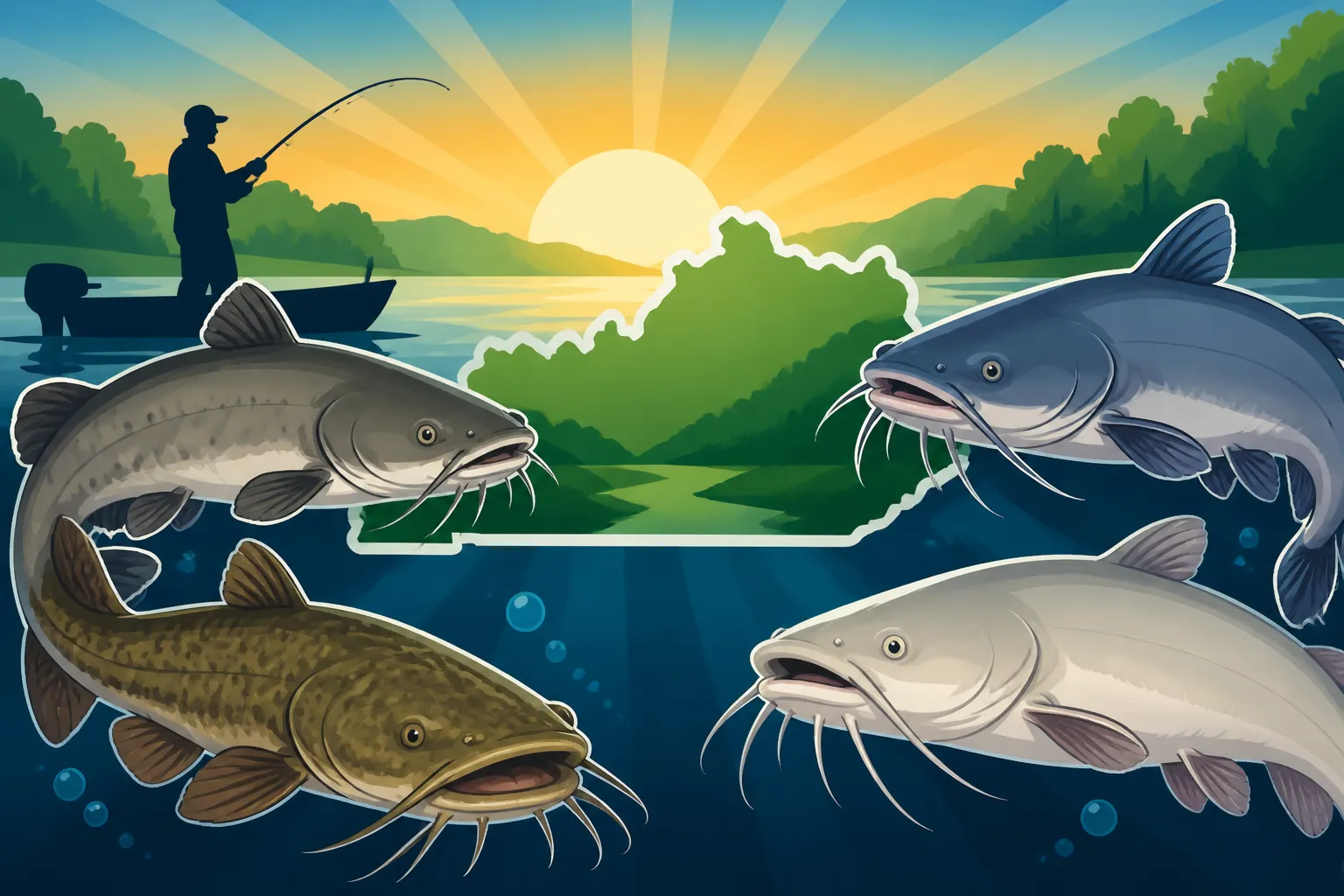
Catfish Species in Kentucky: Channel, Blue, Flathead and White
It's incredibly frustrating when you're out on the water, you hook into a monster, and then you're left scratching your head, wondering "What kind of catfish is this?" Or maybe you've heard whispers of huge blue cats in the Ohio River, but you're not quite sure how to tell them apart from the channel cats you usually catch in your local pond. You might even be missing out on some fantastic fishing opportunities because you don't know the unique habits of Kentucky's diverse whiskered residents. This comprehensive guide is here to unravel the mysteries of Kentucky's catfish species, helping you identify them, understand their preferred habitats, and equip you with the knowledge to target each one effectively, turning those head-scratching moments into confident catches.
An Overview of Kentucky's Catfish Realm
Kentucky is blessed with an abundance of fantastic fishing opportunities, and among the most sought-after species are our incredible catfish. These whiskered bottom-dwellers aren't just plentiful; they offer some of the most exciting and rewarding fishing experiences, whether you're chasing dinner for a fish fry or battling a true river monster. Catfish thrive in a wide range of Kentucky's waters, from the vast expanses of Kentucky Lake and the Ohio River to smaller creeks, ponds, and reservoirs across the Commonwealth. Their adaptability and often voracious appetites make them a favorite target for anglers of all skill levels, year-round.
There’s a common misconception that "a catfish is a catfish," but that couldn't be further from the truth in Kentucky. We're home to several distinct species, each with its own unique characteristics, preferred diets, habitats, and even fighting styles. Understanding these differences is absolutely crucial if you want to become a more successful catfish angler. What works for a feisty channel cat in a farm pond might not even get a nibble from a massive flathead hunkered down in a deep river hole. This guide will help you appreciate the diversity beneath the surface and learn how to adapt your strategies to specific species.
The popularity of catfish fishing in Kentucky isn't just about the thrill of the fight; it's deeply rooted in our culinary traditions. A plate piled high with crispy, golden-fried catfish fillets is a staple at countless family gatherings and community fish fries across the state. This strong cultural connection means that catching catfish isn't just a hobby for many Kentuckians; it's a way of life, providing delicious, fresh protein for the table. Knowing which species tend to be better table fare, and understanding the best ways to catch them, adds another layer of enjoyment to the pursuit.
Why Catfish Hold a Special Place in Kentucky Angling
There's something inherently appealing about catfish. Maybe it's their rugged appearance, their mysterious bottom-dwelling habits, or perhaps it's the sheer power they possess when hooked. For many Kentuckians, fishing for catfish evokes a sense of nostalgia, recalling evenings spent on the bank with family, waiting for the bobber to dip or the rod tip to bend. They're accessible, too; you don't always need fancy equipment or a high-powered boat to find success. A simple rod and reel, some basic bait, and a bit of patience can often yield fantastic results, making catfish fishing a welcoming entry point for new anglers and a cherished tradition for seasoned pros.
The versatility of catfish also contributes to their appeal. You can target them using a myriad of techniques, from passive jug fishing and How to Rig a Trotline for Catfish to active rod-and-reel tactics, whether you're casting from shore or anchored in the middle of a river. They bite throughout the year, though their activity levels certainly fluctuate with the seasons, providing consistent opportunities when other species might be sluggish. This means that no matter your preferred method or the time of year, there’s usually a way to connect with a Kentucky catfish, making them an incredibly reliable and rewarding target.
Beyond the dinner plate and the sporting thrill, catfish play a vital ecological role in Kentucky's aquatic ecosystems. As scavengers and opportunistic predators, they help keep waters clean by consuming decaying matter and controlling populations of smaller fish. Their presence indicates a healthy and balanced aquatic environment. The Kentucky Department of Fish and Wildlife Resources (KDFWR) actively manages catfish populations through stocking programs and regulations to ensure these valuable fisheries remain robust for future generations of anglers, highlighting their importance not just to us, but to the broader ecosystem.
Channel Catfish: The Widespread Favorite
The channel catfish is, without a doubt, Kentucky's most ubiquitous and arguably most beloved catfish species. You'll find them in virtually every sizable body of water across the Commonwealth, from large impoundments like Lake Cumberland and Taylorsville Lake to smaller municipal lakes, farm ponds, and flowing rivers. They're recognized by their slender bodies, deeply forked tails, and often scattered black spots, especially on younger fish. These spots tend to fade as they mature, sometimes disappearing completely on older, larger specimens.
Channel cats are incredibly adaptable, thriving in both clear and turbid waters, as long as there's a good food source and some cover. They’re opportunistic feeders, meaning they'll eat just about anything, which is part of what makes them so much fun to fish for. Their diet includes insects, crustaceans, small fish, and, famously, a variety of decaying organic matter. This wide palate makes them relatively easy to catch and a fantastic species for beginners and seasoned anglers alike.
When you're pulling in a channel cat, you'll often notice a distinct fight. They're not necessarily the hardest fighters in terms of sheer brute strength compared to their blue cat cousins, but they put up a spirited, often acrobatic struggle, especially in open water. They tend to make strong runs and thrash at the surface, which can be quite exciting. For many, catching a stringer of channel cats is the epitome of a classic Kentucky fishing trip, promising good times and even better eating.
Identifying Channel Catfish: A Closer Look
Distinguishing a channel catfish from other species, especially young blue cats, can sometimes be a bit tricky, but there are key features to look for. The most prominent characteristic is their deeply forked tail, which is much more pronounced than that of a flathead or white catfish. Their body is generally sleek and torpedo-shaped. While often spotted, particularly when smaller, the spots are not always present, so don't rely solely on them for identification.
Another important identifier is the number of rays in their anal fin. Channel catfish typically have 24 to 29 rays, which, while not always easy to count on a wriggling fish, gives them a more rounded and convex anal fin margin. In contrast, blue catfish have a straighter, longer anal fin with more rays. Their mouths are typically smaller compared to a flathead's, and their head is relatively narrow. If you're unsure, comparing the anal fin shape and tail fork will usually give you the answer. For a deeper dive into identifying the different catfish species, you might want to pick up a good field guide on Amazon.
Their coloration can vary depending on the water clarity and substrate of their habitat. In clear, rocky rivers, they might have a more olive-brown back and creamy white belly, while in murkier, muddy waters, they can appear darker, almost blackish-green. These variations are normal and shouldn't confuse you once you're familiar with their fundamental anatomical features. Remember, the deeply forked tail and convex anal fin are your best friends when trying to confirm a channel cat.
Prime Channel Catfish Habitats and How to Target Them
Channel catfish are incredibly versatile when it comes to habitat, making them accessible to almost every angler in Kentucky. In large reservoirs, you'll often find them congregating in creek channels, around submerged timber, near old roadbeds, or along ledges that drop into deeper water. They also love areas with moderate current, such as river bends or downstream of dams. For pond anglers, channel cats will relate to structure like fallen trees, brush piles, or simply cruise the deeper areas.
When targeting channel catfish, bait choice is paramount, and they're not particularly picky. Stink baits, chicken livers, cut bait (especially shad or herring), nightcrawlers, and even hot dogs are all highly effective. Many anglers swear by homemade concoctions, letting them sit in the sun for a day or two to really get that potent aroma going. The key is often smell; they use their barbels (whiskers) to detect food by scent, so a strong-smelling bait can be irresistible. Consider trying different baits throughout the day to see what they prefer. Best Bait for Channel Catfish Fishing offers even more detailed suggestions.
As for techniques, bottom fishing is the most common and effective method. A simple Carolina rig with an egg sinker, swivel, and a leader ending in a circle hook works wonders. You want your bait to be right on the bottom where they're feeding. Night Fishing Techniques for Catfish can also be incredibly productive, as channel cats are often more active after dark. Don't be afraid to experiment with your rig, your bait, and your location. If one spot isn't producing, move to another; these fish are often nomadic, especially when searching for food.
Blue Catfish: The River Monsters
If you're looking for a true heavyweight fight, the blue catfish is your target. These magnificent fish are the largest catfish species in Kentucky, capable of growing to incredible sizes. While they're found in many of Kentucky's larger rivers and reservoirs, their stronghold is undoubtedly the mighty Ohio River and large impoundments like Kentucky Lake. Anglers consistently pull trophy-sized blue cats from these waters, with fish weighing in excess of 50 pounds being a real possibility. Kentucky's Blue Catfish State Record Explained will give you an idea of just how massive these fish can get!
Blue catfish are easily distinguished from channel cats by their slate-blue coloration, often fading to white on their belly, and their distinctively straight-edged anal fin. Unlike the channel cat's rounded anal fin, the blue cat's is much longer and has a noticeably flat or concave margin, with 30-35 rays. Their tail is also deeply forked, similar to a channel cat, but their head is typically broader and more imposing, especially on larger specimens. These are truly impressive fish that command respect.
While channel cats are omnivorous scavengers, blue cats are primarily piscivorous, meaning they prefer to eat other fish. Their diet consists mainly of shad, skipjack herring, drum, and other baitfish. This preference for live or fresh cut bait is a critical factor when planning your fishing strategy. You'll need to adjust your approach significantly from what you might use for channel cats, focusing on bait presentation that mimics their natural prey.
Identifying Blue Catfish: Key Distinctions
When you've got a big catfish on the line, the excitement can make identification tough, but knowing the key features of a blue cat will help you confidently name your catch. As mentioned, the most reliable identifier is the anal fin. The blue catfish has a very long, straight-edged, or slightly concave anal fin with 30-35 rays, while the channel catfish has a shorter, more rounded, convex anal fin with 24-29 rays. This difference is usually quite clear once you know what to look for.
Their coloration is another hint: blue catfish are typically a uniform slate-blue or gray on their back and sides, lightening to a white belly. They generally lack the spots that channel catfish often have, especially as adults. Their heads are also usually larger and more robust than a channel cat's, contributing to their powerful appearance. While both species have deeply forked tails, the combination of the anal fin, coloration, and head shape usually confirms a blue cat. This is where a side-by-side comparison like in Channel Catfish Vs Blue Catfish: How to Tell Them Apart can be really helpful.
Size is often a strong indicator, though not always definitive for smaller fish. If you've caught a catfish that's pushing 20, 30, or even 50 pounds, chances are overwhelmingly high that it's a blue catfish. While channel cats can grow large, they rarely reach the gargantuan proportions of a mature blue cat. Always remember to double-check those anatomical features, especially the anal fin, before making a final judgment.
Targeting Blue Catfish: Heavy Tackle and Fresh Bait
Fishing for blue catfish requires a different approach than chasing channel cats. Because of their potential for massive size and incredible strength, you need to step up your gear. This means heavy-duty rods and reels, spooled with strong braided line in the 50-80 pound test range, and stout circle hooks (often 7/0 to 10/0 or larger). Many anglers use specialized catfish rods, which you can find a good selection of on Amazon, designed to handle the brutal force of a big blue. These fish are not to be underestimated; inadequate gear can lead to heartbreaking break-offs.
Bait is another critical component. Forget the stink baits and hot dogs; blue cats want fresh cut bait. Skipjack herring, shad, carp, and drum are all excellent choices. Many successful blue cat anglers will spend time catching their own bait using cast nets or smaller tackle. The fresher the bait, the better. Cut your bait into chunks that are appropriate for the size of fish you're targeting – larger chunks for larger fish. Presenting a large, oily piece of fresh cut bait on the bottom is often the ticket. Best Bait for Blue Catfish Fishing provides fantastic details on bait preparation and presentation.
Prime locations for blue cats include deep river channels, submerged humps, sharp drops, and areas with strong current, especially below dams or around wing dams on the Ohio River. They often relate to structure like rock piles, mussel beds, and deep holes. You'll frequently find them in schools, so if you catch one, there are likely more nearby. Techniques like bottom fishing with a heavy Carolina rig or a three-way swivel rig are standard. Many serious blue cat anglers employ Jug Fishing for Catfish: A Beginner's Guide or anchoring techniques to effectively cover large areas of deep water. They are often active day and night, but some of the biggest trophies are caught after dark. What Time of Year Is Best for Night Catfishing on Kentucky Lake offers great insight into nocturnal blue cat habits.
Flathead Catfish: Ambush Predators of the Depths
The flathead catfish is the solitary hunter of Kentucky's catfish species, a true ambush predator with a distinctive look and a preference for live bait. Unlike the scavenging channel and blue cats, flatheads are voracious predators that prefer to eat fresh, live fish. They can grow to impressive sizes, often rivaling blue cats in weight, and offer an incredibly powerful, drawn-out fight that many anglers consider the pinnacle of freshwater fishing.
Flatheads are easily identifiable by their uniquely flat, broad heads (hence the name) and their mottled, yellowish-brown to olive-brown coloration, which helps them camouflage against the river bottom. Their lower jaw protrudes beyond the upper jaw, giving them a perpetually grumpy look, and their eyes are relatively small. Perhaps the most distinct feature is their tail, which is rounded or only slightly notched, not deeply forked like channel or blue catfish. This tail shape is a key identifier.
You'll typically find flatheads in larger rivers and reservoirs, particularly in slow-moving or stagnant sections with plenty of heavy cover. Think log jams, submerged trees, rock piles, and deep scour holes. They are territorial and prefer to hunker down in these structures, waiting to ambush unsuspecting prey. This makes them a challenging but incredibly rewarding fish to target, as finding their lair is often half the battle.
Identifying Flathead Catfish: Unmistakable Features
When it comes to distinguishing a flathead catfish, there are a few features that make it quite unmistakable. The most obvious is its head, which is noticeably broad and flattened. This contrasts sharply with the narrower, more rounded heads of channel and blue catfish. Their eyes are also relatively small and set on top of their flattened head, giving them excellent upward vision for ambushing prey.
Another defining characteristic is their lower jaw, which extends beyond their upper jaw. This "underbite" is very pronounced and a reliable identifier. While coloration can vary, flatheads generally have a mottled, camouflaged appearance with shades of yellow, brown, and olive, often with darker blotches or spots over a lighter background. This dappled pattern helps them blend in perfectly with submerged timber and rocky bottoms.
However, the most definitive anatomical difference from other catfish in Kentucky is their tail fin. Unlike the deeply forked tails of channel and blue cats, the flathead's tail is either rounded or only very slightly notched, appearing almost square. If you're comparing a flathead to a channel cat, for instance, this tail difference is immediately apparent. Flathead Catfish Vs Channel Catfish: How to Tell Them Apart highlights these crucial distinctions, ensuring you know exactly what you've hooked.
Flathead Haunts and Live Bait Tactics
Flathead catfish are creatures of habit and structure. They prefer slow-moving water in large rivers and reservoirs, but always near heavy cover. Think massive log jams, deep brush piles, undercut banks, and large rock formations. These spots provide them with a perfect ambush point and a safe haven. They are particularly active at night, moving out from their daytime lairs to hunt, making Night Fishing Techniques for Catfish an absolute must for serious flathead anglers. During the day, they'll often be tucked deep into the heaviest cover, making them tough to extract.
The key to catching flatheads is live bait. They are not interested in stink baits or cut bait that isn't absolutely fresh. Their preferred menu includes live bluegill, sunfish, shad, or even smaller carp or suckers. The size of your bait should match the size of the flathead you're hoping to catch – don't be afraid to use a 6- to 8-inch live bait for trophy flatheads. You'll need stout gear, similar to blue cat fishing, with heavy-duty rods and reels, strong braided line (60-100 lb test), and large circle hooks (8/0 to 12/0). Many anglers find excellent heavy-duty tackle options on Amazon for this kind of fishing.
A standard setup involves a heavy Carolina rig or a three-way swivel rig, designed to keep your live bait near the bottom and close to cover. Positioning your bait right on the edge of a log jam or in a deep hole adjacent to heavy structure is crucial. Patience is also key; flatheads often take their time with a bait, and you might feel a few tentative bumps before the rod really doubles over. When it does, hold on tight – these fish will fight hard to get back into their sanctuary, often making powerful, grinding runs.
White Catfish: The Lesser-Known Cousin
The white catfish is often the overlooked member of Kentucky's catfish family, frequently mistaken for a channel catfish, especially when smaller. While not as widespread or as large as their channel, blue, or flathead relatives, white catfish do inhabit certain waters in Kentucky, offering a unique angling experience. They tend to be smaller than channel cats on average, typically weighing a few pounds, but can still provide a fun fight on light tackle.
White catfish are recognizable by their somewhat stockier body shape compared to the more slender channel cat, and a tail that is only moderately forked, less deeply split than a channel or blue catfish. Their most distinctive feature, however, is their coloration: they are typically silvery-white to olive-gray on their sides, with a pale or white belly. They do not have the spots often seen on channel catfish, and their barbels (whiskers) are usually white or pale, in contrast to the darker barbels of channel and blue cats.
You'll generally find white catfish in sluggish rivers, larger creeks, and impoundments, often preferring slightly brackish (if applicable to some KY rivers, though less common inland) or slow-moving freshwater. They are more tolerant of poor water quality than some other catfish species. While they may not offer the trophy potential of a blue or flathead, they are excellent table fare and a welcome addition to any stringer.
Identifying White Catfish: Subtle Differences
Identifying a white catfish requires a keen eye, as they can easily be confused with smaller channel catfish at first glance. The most reliable distinguishing features are their tail fin and their body shape. While channel cats have a deeply forked tail, the white catfish has a more moderately forked tail, almost intermediate between a channel cat and a flathead in its "forkiness." This is a crucial anatomical difference to observe.
Their body shape is generally stockier and less sleek than a channel cat, appearing a bit more compressed side-to-side. Coloration is another key identifier: white catfish typically have an overall paler appearance, often a silvery-white or light olive-gray, with noticeably white barbels. Channel catfish, even without spots, tend to have darker, often blackish, barbels. The absence of spots, combined with the paler coloration and less-forked tail, are your best clues. For confirmation, Are White Catfish Common in Kentucky Waters? might clarify where you're most likely to encounter them.
Another subtle but important difference is their anal fin ray count. White catfish typically have 19-24 anal fin rays, which is fewer than channel catfish (24-29) and significantly fewer than blue catfish (30-35). While not the easiest to count on a lively fish, this is a definitive scientific characteristic that sets them apart. If you're meticulously trying to identify a catch, these fin ray counts can be the final piece of the puzzle.
White Catfish Habitats and Fishing Tips
White catfish tend to favor different types of water than their larger cousins. You'll often find them in sluggish rivers, large creeks with slower current, and larger impoundments that might have slightly muddier or warmer waters. They aren't typically found in the fast, deep currents that blue and flathead catfish prefer. Look for them around submerged vegetation, brush piles, or along soft bottoms in moderate depths. They are less structure-oriented than flatheads but will still utilize cover.
When it comes to bait, white catfish are quite cooperative. They share some of the channel cat's omnivorous tendencies, so baits like worms, chicken livers, small pieces of cut bait, corn, and even dough balls can be effective. They generally respond well to natural baits. Because they don't grow to extreme sizes, lighter tackle is perfectly suitable and makes for a more exciting fight. A medium-light spinning rod with 6-10 pound test line is often ideal.
Bottom fishing with a simple paternoster rig or a small Carolina rig is usually all you need. Focus on areas where you suspect they might be feeding, such as drop-offs near weed beds or along creek channels. They can be caught throughout the day, though dawn and dusk often see increased activity. Don't be surprised if you catch a few smaller channel cats or even some large panfish while targeting white catfish – their habitats and feeding preferences often overlap.
Identifying Kentucky Catfish Species: A Comparative Table
Sometimes, the best way to really nail down which catfish you've caught is to have a quick reference. While a detailed field guide is always your best friend, this table offers a snapshot of the most crucial identification features for Kentucky's main catfish species. Print it out or save it to your phone for quick checks while you're out on the water.
| Feature | Channel Catfish | Blue Catfish | Flathead Catfish | White Catfish |
|---|---|---|---|---|
| Tail Fin | Deeply forked | Deeply forked | Rounded or slightly notched | Moderately forked |
| Anal Fin | Rounded/convex, 24-29 rays | Straight/concave, 30-35 rays | Rounded, 14-17 rays | Rounded, 19-24 rays |
| Head Shape | Narrow, rounded | Broad, rounded | Very broad, flattened | Stockier, somewhat rounded |
| Lower Jaw | Even with upper | Even with upper | Protrudes beyond upper | Even with upper |
| Coloration | Olive/gray, often spotted | Uniform slate blue/gray | Mottled yellow/brown | Silvery-white/olive |
| Barbels | Usually dark | Dark | Dark | Pale/white |
| Typical Size | 1-10 lbs (up to 30+ lbs) | 10-50+ lbs (can exceed 100 lbs) | 5-40 lbs (can exceed 80 lbs) | 1-5 lbs (up to 10+ lbs) |
| Primary Diet | Omnivorous (scavenger) | Piscivorous (fish eater) | Piscivorous (live fish only) | Omnivorous (scavenger) |
Remember, these are general guidelines, and fish coloration can vary. Always look at a combination of features to make the most accurate identification. The anal fin ray count and tail shape are often the most reliable markers for distinguishing between channel, blue, and white catfish, while the head shape and jaw are dead giveaways for flatheads.
Catfish Regulations and Conservation in Kentucky
Understanding the rules and doing your part for conservation is just as important as knowing how to catch them. The Kentucky Department of Fish and Wildlife Resources (KDFWR) has specific regulations for catfish, including daily creel limits and sometimes size limits, designed to maintain healthy populations and ensure sustainable fishing for everyone. It's vital to check the current KDFWR fishing guide every year, as regulations can change.
For instance, Kentucky has a statewide daily limit for catfish, often a combined total for different species, and sometimes a rule about how many "trophy" sized fish you can keep. Kentucky Catfish Daily Limit and Trophy Fish Rule explains this in detail. What's often overlooked is that blue and channel catfish usually count towards the same daily limit, as clarified in Why Blue and Channel Catfish Count Toward the Same Kentucky Limit. This means you can't just fill your cooler with 15 channel cats and then another 15 blue cats; they're generally grouped together for conservation purposes.
Respecting these limits and practicing responsible catch-and-release, especially for large breeding-size fish, helps ensure that Kentucky's catfish populations remain robust for years to come. Remember, a quick photo and a gentle release of a trophy-sized blue or flathead can contribute significantly to the genetic health and future fishing opportunities in that body of water.
Statewide Bag and Size Limits for Catfish
Kentucky's fishing regulations are in place to manage fish populations responsibly, ensuring there are plenty of fish for future generations. When it comes to catfish, there's usually a statewide aggregate daily limit for channel, blue, and white catfish combined. This means you can keep a certain total number of these three species per day. It’s critical to remember that Kentucky Catfish Limit: 15 Fish, Only 1 Over 25 Inches is a common regulation, meaning you might only be allowed to keep one fish over a certain length (like 25 inches) within that daily limit. This "trophy fish" rule is particularly important for protecting the larger, more mature breeders.
There are also specific rules about How Many Catfish Over 25 Inches Can You Keep?, which directly relates to the trophy fish component of the daily limit. These regulations are designed to allow anglers to keep plenty of smaller, delicious eating-sized fish, while protecting the larger, older fish that are crucial for spawning and maintaining genetic diversity. It's a balance between recreational harvest and long-term sustainability. Always verify the most current regulations directly from the KDFWR, as they can update these numbers annually.
Flathead catfish sometimes have their own separate daily limits, often a smaller number due to their slower growth rates and specific predatory role in the ecosystem. Because flatheads are primarily live-bait predators and less prone to overharvest by conventional methods, their management might differ slightly. Staying informed about these nuances is key to being a legal and responsible angler in Kentucky, and it protects the resource we all love.
The Importance of Catch and Release for Trophy Catfish
While a fresh catfish dinner is a highlight for many, practicing selective harvest and catch-and-release, particularly for the biggest blue and flathead catfish, is incredibly important. These large fish are often the prime spawners, contributing significantly to the next generation of catfish in our lakes and rivers. Removing too many of the largest individuals can have long-term negative impacts on the fishery's health and the potential for future trophy catches.
Think of it this way: a 50-pound blue cat has likely survived many years, overcome numerous challenges, and contributed countless offspring to the population. Allowing that fish to continue its life cycle ensures that those valuable genes and reproductive capabilities remain in the water. Plus, imagine the thrill of another angler catching that same fish, perhaps even bigger, a few years down the line! It fosters a strong community of conservation-minded anglers.
When you do decide to release a large catfish, do so quickly and carefully. Minimize its time out of water, support its body horizontally, and avoid handling it by the jaw alone, which can cause injury. Revive the fish by holding it gently in the water, allowing it to move fresh water over its gills until it's strong enough to swim away on its own. A little care goes a long way in ensuring these magnificent fish continue to thrive.
Top Catfish Hotspots in Kentucky
Kentucky is blessed with an abundance of waters perfect for chasing catfish, from sprawling reservoirs to winding rivers. Knowing where to go is just as important as knowing what to use. While catfish can be found almost anywhere, some locations are legendary for their consistent action and the potential for true trophy catches.
The Ohio River, forming Kentucky's northern border, is a prime destination for massive blue and flathead catfish. Its deep channels, strong currents, and abundant baitfish populations create the perfect environment for these river monsters. Anglers regularly pull in fish exceeding 50 pounds from its depths, making it a bucket-list destination for serious catfishermen. Similarly, Kentucky Lake, with its vast expanse and fertile waters, is renowned for its excellent blue and channel catfish fishing, particularly during the warmer months when the Kentucky Lake Summer Catfish Bite is on fire.
Beyond these giants, numerous other lakes and rivers offer fantastic opportunities for all species. Lake Barkley, connected to Kentucky Lake, also boasts a robust catfish population. Smaller reservoirs like Taylorsville Lake and Barren River Lake are excellent for channel catfish, especially for those looking for a steady bite and good eating-sized fish. Even many local community lakes and farm ponds provide great access to channel and sometimes white catfish, proving you don't always need to travel far to find success.
Ohio River: Home of Trophy Blue and Flathead Catfish
When you talk about trophy catfish in Kentucky, the conversation almost always starts with the Ohio River. This massive waterway is a behemoth, offering incredible depth, current, and structure that big blue and flathead catfish absolutely thrive in. Its vastness can be intimidating, but once you learn to read the river, you'll discover countless honey holes. Look for deep holes, channel swings, scour holes below dams, and particularly large log jams or rock formations. These are the natural hangouts for the river's biggest residents.
Fishing the Ohio River requires heavy-duty gear and a healthy respect for the river's powerful currents and commercial traffic. Many anglers use heavy-bottom rigs, often with 8-16 ounces of lead, to keep their fresh cut bait (for blues) or live bait (for flatheads) on the bottom in the swift current. Anchor strategically to present your baits effectively in productive zones. Best Catfish Fishing Spots on Kentucky's Ohio River provides an in-depth look at specific areas and tactics for this incredible fishery, guiding you to some of the most productive stretches.
Success on the Ohio isn't just about bait and tackle; it's about understanding river dynamics. Pay attention to current breaks, eddies, and subtle changes in depth. Fish will often hold in these areas to conserve energy and ambush prey. While boat fishing allows access to the best spots, there are also numerous public access points and bank fishing opportunities, especially below dams and at public parks, where you can still connect with some respectable fish.
Kentucky Lake and Lake Barkley: Abundant Channel and Blue Catfish
Kentucky Lake and its sister lake, Lake Barkley, are synonymous with exceptional freshwater fishing, and catfish are no exception. These massive impoundments, connected by a canal, offer incredible habitat for both channel and blue catfish, providing a fantastic experience for anglers seeking both numbers and size. The lakes are characterized by vast open water, but also countless bays, creek channels, and submerged timber, all of which hold catfish.
For channel catfish, focus on creek channels, secondary points, and the edges of flats, especially those with some submerged brush or grass. Chicken livers, nightcrawlers, and stink baits work exceptionally well here. Blue catfish will often be found in the main lake channels, around deep humps, along old river beds, and near structure that holds schools of shad or other baitfish. Fresh cut shad is typically the go-to bait for these larger blues.
Both lakes offer excellent fishing from a boat, allowing you to explore the extensive submerged creek channels and offshore structures. However, there are also numerous bank access points, especially around state parks and public ramps, where you can find great fishing, particularly for channel cats. Early morning and evening hours often provide the best bite, but What Time of Year Is Best for Night Catfishing on Kentucky Lake highlights the incredible night fishing opportunities these lakes offer for bigger blues, especially during the warmer months when the catfish are actively feeding throughout the dark hours.
Essential Gear and Techniques for Catfish Anglers
To truly enjoy catfish fishing in Kentucky, having the right gear and understanding effective techniques is crucial. While you don't need to break the bank, investing in quality equipment tailored to the species you're targeting will significantly improve your success and enjoyment. From robust rods and reels to specialized baits and rigs, each component plays a role in bringing those whiskered fighters to the boat or bank.
For channel and white catfish, which are typically smaller, a medium-heavy spinning or baitcasting combo with 12-20 pound test monofilament or braided line is often sufficient. This allows for good casting distance and enough backbone to handle a feisty fish. When stepping up to blue and flathead catfish, however, you'll need much heavier gear. Think heavy-action rods, robust baitcasting reels, and braided line in the 50-80 pound test range, especially for the Ohio River or Kentucky Lake. This heavy tackle helps you withstand their powerful runs and pull them out of heavy cover.
Beyond rods and reels, a well-stocked tackle box for catfish should include a variety of sinkers (egg sinkers, no-roll sinkers), swivels, and a range of circle hooks appropriate for your target species and bait size. A good pair of pliers for hook removal, a sturdy stringer or livewell, and a net with a rubberized coating (to protect the fish's slime coat) are also invaluable. And of course, don't forget a comfortable chair for those long waits on the bank!
Bait and Rigging Strategies for Different Catfish Species
The beauty of catfish fishing lies in the diversity of baits and rigs you can employ, often specific to the species you're after. For channel and white catfish, which are more omnivorous, your options are vast. Best Bait for Channel Catfish Fishing details favorites like chicken livers, punch baits, stink baits, worms, and even prepared dough baits. A simple Carolina rig (a sliding sinker above a swivel, with a leader and hook) is incredibly effective for presenting these baits on the bottom. A slip bobber rig can also work well, especially in shallower water or when you want to keep your bait just off the bottom.
Blue catfish are primarily piscivorous, meaning they prefer fresh cut bait. Shad, skipjack herring, carp, and even smaller panfish cut into chunks are irresistible to them. The key here is freshness and scent. Use larger, sturdier hooks (7/0-10/0 circle hooks are common) and heavier leaders. A traditional bottom rig, like a Carolina rig or a three-way swivel rig, is standard, often with a heavier sinker to hold against current. Best Bait for Blue Catfish Fishing really dives deep into getting the right cut bait presentation for these giants.
Flathead catfish are the pickiest of the bunch, almost exclusively preferring live bait. Bluegill, sunfish, small carp, or suckers are prime choices. Present your live bait on a sturdy circle hook (8/0-12/0) with a heavy leader, usually on a Carolina rig or a three-way swivel rig, keeping the bait near cover. It's crucial to use bait that is lively and appealing. Many dedicated flathead anglers will spend time catching their own fresh live bait before a trip. For those wanting to employ more passive methods, Jug Fishing for Catfish: A Beginner's Guide and How to Rig a Trotline for Catfish offer fantastic ways to target various catfish species, especially in larger bodies of water where covering more area is beneficial.
Advanced Techniques for Targeting Trophy Catfish
Once you've mastered the basics, there are several advanced techniques that can significantly increase your chances of landing those truly monumental catfish. For blue cats, understanding hydrographic maps and using sonar to locate deep channels, humps, and schools of baitfish is paramount. Precision anchoring to stay directly over promising structure is also key. Many trophy anglers use multiple rods, each with a different bait or at a slightly different depth, to pattern the fish.
For flatheads, the game often revolves around night fishing and precise bait placement. Knowing exactly where those log jams and deep holes are, and patiently presenting a lively bait right in their ambush zone after dark, is often the secret. Some anglers even "power drift" baits, slowly drifting a boat over known flathead haunts while keeping live baits on the bottom, covering more territory. Using specialized equipment, such as heavy-duty cast nets to catch fresh bait and quality fish finders (often available on Amazon), can also give you a significant edge in these advanced pursuits.
Regardless of the species, consistent success with trophy catfish often comes down to dedication, persistence, and meticulous attention to detail. Observing lunar phases, understanding seasonal movements (like catfish moving into shallower water to spawn or deeper water in winter), and keeping a detailed fishing log can all provide valuable insights over time. Don't be afraid to experiment, learn from your failures, and adapt your approach based on what the fish are telling you.
Disclaimer
This article is for general informational purposes only and does not constitute professional advice. Laws, prices and regulations vary by location and change over time. Consult a qualified professional for guidance on your specific situation.